Just finished the umpteenth draft of your book?
Sick to death of innumerable iterations, cutting, pasting, checking and all the drudgery associated with editing (at least, from a writer’s point of view)?
We’ve all been there.
In fact, that’s exactly where I am at the moment.
So, here’s some advice that could stop you from making a decision you might regret.
A Word of Warning!
Don’t give up on your editing until you genuinely feel that you cannot take it any further. If you are simply tired of the editing process, park that piece of work and do some writing. It will not only make you feel better, but you will return to the editing process with renewed vigour and a fresh perspective.
Don’t be tempted just to clear the decks and ping out a piece of unfinished work. It won’t get you anywhere and you will regret it. So, once you have indulged your passion for writing, return to that incomplete work and finish it. Editing, after all, accounts for a good half of writing. Without it, your book won’t be worth reading.
Edit, edit, edit and edit again
To date, I have completed at least 11 major revisions of my book with additional minor changes. Wearisome? Definitely. Worth it? Absolutely. If you are serious about your work, you are in for a long haul. This is a marathon, not a sprint. So let’s get started.
I find it best to work on a physical manuscript. It’s much easier to spot mistakes on paper than it is on a screen. Once you have done your initial editing, read your text aloud. This will flag up more faults and help you to focus on the rhythm of your writing. It also helps to root out clunky sentences and areas lacking clarity.
Do remember to spell-check your MS every time you make a revision. When making changes, faults can easily creep into the script.
Skill up and take an editing course
In order to improve my editing skills, I took a basic fiction-editing course through The Chartered Institute of Editing and Proofreading (CIEP). Tackling bulky manuscripts can be overwhelming. However, this course taught me how to deal with a vast quantity of material by creating a spreadsheet.
Suddenly, I had a manageable overview of my book and could track its contents. I could plot story arcs and see at a glance where something was out of place or superfluous. This course was absolutely invaluable and I would recommend it – or something similar – to all authors.
Find beta readers
These need to be people you can trust to be honest, engaged and helpful. Avoid people who are either deliberately destructive (we all know who those are!) or so close to you that they are unlikely to provide any helpful feedback (“It’s lovely, darling”).
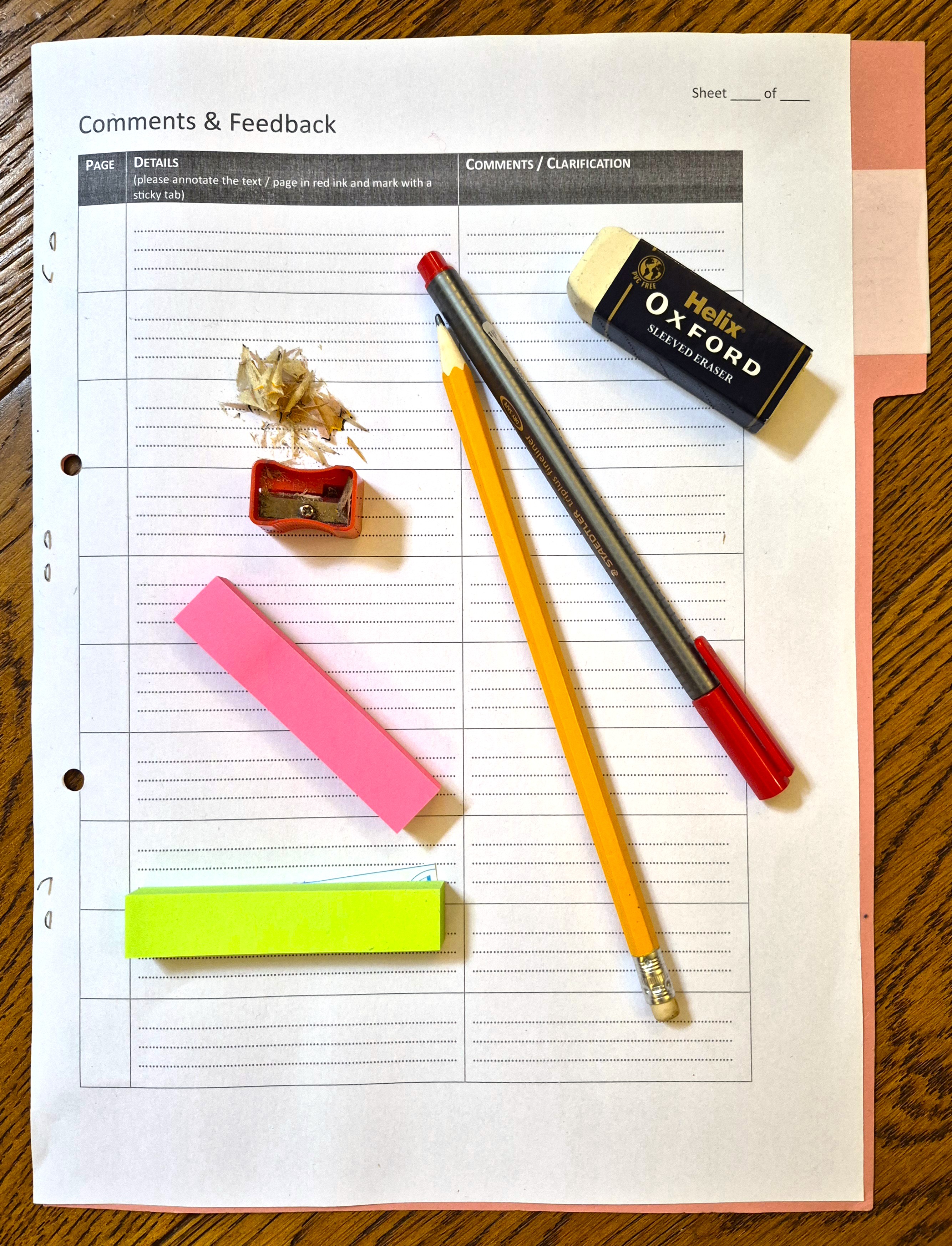
Provide your volunteers with your manuscript on a ring binder + a front sheet with sections for page numbers and comments. I also give my readers a complimentary pencil case with red editing pens, pencils, sticky tags, erasers and a sharpener.
When your readers have finished, reward them with a nice present e.g. a bottle of wine, bunch of flowers, box of chocolates. Don’t forget, they have spent their valuable free time reading your book. If someone agrees to the task, but then decides they have not got time to do it, don’t be hurt. Life has a way of overtaking everyone. Just find someone else.
Learn to take constructive criticism
This takes experience – and some courage. You have to distance yourself from your book-baby and look at it with a critical eye. Take a deep breath and dive in.
Read each comment and re-visit the relevant page. It may be painful at first, but this is a valuable learning curve. Beta readers’ comments may be quite general, but nonetheless worth having.
For instance, one reader told me that she could not keep track of some of the characters in my book as there were long gaps between their appearances.
Consequently, I decided to make a chart, mapping all the characters and which pages they appeared on. This really helped me to understand what the reader was saying (she was right!) and to address the problem by adding a few extra words to remind subsequent readers of the character’s identity.
Enter your book/short story into a competition
I had never done this before but, as many of the competitions appear to have links to literary agencies (e.g. sponsorship, judges), I thought this might be a way of getting the attention of an agent.
It’s early days and no results have yet appeared. (I’m not expecting miracles!) However, the process of entering competitions proved helpful in unexpected ways. Why?
It made me finesse my text, especially the crucial opening chapters.
I also realised that I had written a lot of short stories that were languishing in forgotten folders on my PC. Entering them into a competition was the incentive to corral and edit them. Now I have the basis of a new anthology.
Competitions also provide valuable practice – and advice – on writing synopses. These are not book blurbs, but concise summaries of the main points of your story with spoilers. As such, they really help to focus the mind and prepare you for approaching agents.
Many competitions, such as Bridport, offer invaluable advice via their websites, newsletters and webinars. I attended one webinar (£10 for one hour) which was given by an agent and a commissioning editor. They offered great advice – especially regarding the importance of a well-written Query Letter – and an enlightening insight into how ‘the other side’ thinks.


