Rochester’s Medieval Mystery

DSC_0383-b-72dpiWhen researching medieval pilgrims for my story The Baker’s Boy, I was struck by the many facets of what resembled an early form of the tourist industry.

The subject of my research was William of Perth, an obscure Scottish baker who, having met an untimely death outside Rochester, became not only its patron saint but whose shrine also provided a much-needed source of income for its Cathedral and Benedictine priory.

What fascinated me about William was how someone who would probably have been regarded as a complete foreigner about whom little or nothing was known, was catapulted to saintly stardom and whose shrine became a ‘must-see’ for pilgrims.

Very little is known of William’s former life and what we have dates from a source printed some 300 years after his death. However, the reasons underpinning his celebrity probably have something to do with the rise of another medieval saint, Thomas Becket.

Formerly Chancellor of England, Becket had become Archbishop of Canterbury and famously opposed King Henry II’s attempt to subject ‘criminous clerks’ to the rule of secular law. Whether or not Henry actually ordered Becket’s death or, as he claimed, his words of frustration were wrongly interpreted as a signal for decisive action, Becket was subsequently murdered in Canterbury Cathedral by four of the king’s knights.

Following his death in 1170, Becket’s tomb rapidly became a focus of pilgrimage – a trend which can only have been strengthened by his canonisation in 1173. Although this was not the quickest canonisation – that distinction belongs to St Anthony of Padua who was canonised in under a year – Becket was, nonetheless, something of a ‘fast-track’ saint.

What probably accounted for Becket’s popularity was that he was contemporary, not a half-forgotten Saxon or Roman saint, but a man famous in his lifetime both for his status and his long-running conflict with the king.

Becket’s brutal death shocked a nation and, almost overnight, his tomb became a place of pilgrimage. The popular reaction to his death might well have resembled the extraordinary outpouring of grief on the death of Princess Diana.

Becket’s death had a profound impact on both the Cathedral and town of Canterbury, attracting pilgrims from all over Britain and Europe and becoming the focus of an early and lucrative form of tourist trade. It has been estimated that, in one year alone, some 100,000 pilgrims visited Becket’s shrine. They brought not only their devotion, but also their money.

To illustrate the wealth generated by medieval shrines, here is a contemporary account of Becket’s tomb: “the shrine appeared, blazing with jewels and gold; the wooden sides were plated with gold, and damasked with gold wire, and embossed with innumerable pearls and jewels and rings, cramped together on this gold ground.”

During the 12th century, Rochester Cathedral was confronted with serious challenges which could have resulted in its permanent decline. In 1137 and 1179, it suffered two devastating fires. Then, in 1199, Pope Innocent III imposed an unprecedented tax of one fortieth of all income on the clergy in order to finance a crusade. In the same year, a note in a contemporary text records an investigation into Rochester Priory’s debts.

It seems clear that Rochester was in financial difficulties.

In 1201, the untimely death of an unknown pilgrim just outside Rochester could well have saved the Cathedral and Priory from economic catastrophe.

Was the saintly cult of William of Perth modelled on that of Becket? It certainly seems likely.

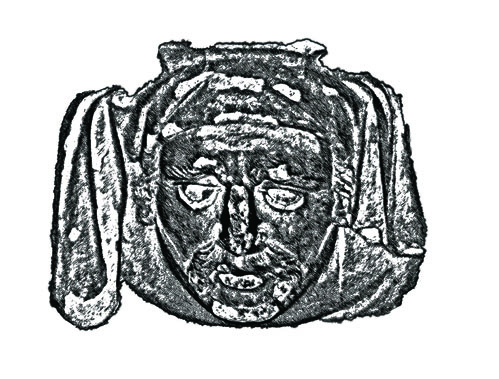
Without doubt, William’s shrine was extremely popular. The Pilgrim Steps that led to his shrine have been so worn down by pilgrims that they are now preserved under a wooden frame. The funds raised from medieval pilgrims almost certainly contributed to the renovation of the Cathedral.

In this respect, it is tempting to see William’s career as contemporary medieval saint running in parallel with that of Thomas Becket. Sadly, their shrines both shared the same fate, being destroyed c.1538 as a result of Henry VIII’s dissolution of the monasteries.

Additional Information

The Baker’s Boy is one of a collection of stories inspired by Rochester Cathedral, its history and treasures which appears in T. Thurai’s new book Barley Bread and Cheese. Click here

To learn more about Rochester Cathedral, click here

For T. Thurai’s website, click here
Posted in Uncategorized | Leave a comment

A Tale of Little Green Men

GM-0061In one of its most ambitious graphics yet, Google recently displayed an animated title with a humorous portrayal of a flying saucer piloted by a tiny spaceman. This commemorated the 66th anniversary of the Roswell incident in New Mexico in which the crash landing of an Unidentified Flying Object spawned numerous theories relating to alien visitors.

It is probably no coincidence that, when the first pulsar was spotted some 20 years later in 1967, regular flashes of light from deep space became known to astronomers as LGMs – an acronym for ‘Little Green Men’.

But you do not have to search outer space to find LGMs. They have been living here among us for centuries – and many have settled in churches. At least 25 reside in Rochester Cathedral.

The origins of these little green men are almost as mysterious as those of the supposed aliens at Roswell. Carvings of leaf masks and foliate heads can be traced back hundreds of years, springing up in ancient Rome, Iraq, Nepal, Borneo and Rajasthan.

Possibly one of the earliest occurrences of a foliate head in a Christian context is that of the foliate head that appears on the tomb of St Abre. This dates from c 400 AD and is now located in the church of St Hilaire-Le-Grand in Poitiers.

Carvings of green men continued to flourish throughout the middle ages, especially in churches. Several 14th century examples can be seen on the scalloped stone canopy which adorns the tomb of Bishop Hamo of Hythe located near the Pilgrim Steps in the North Quire Aisle of Rochester Cathedral.

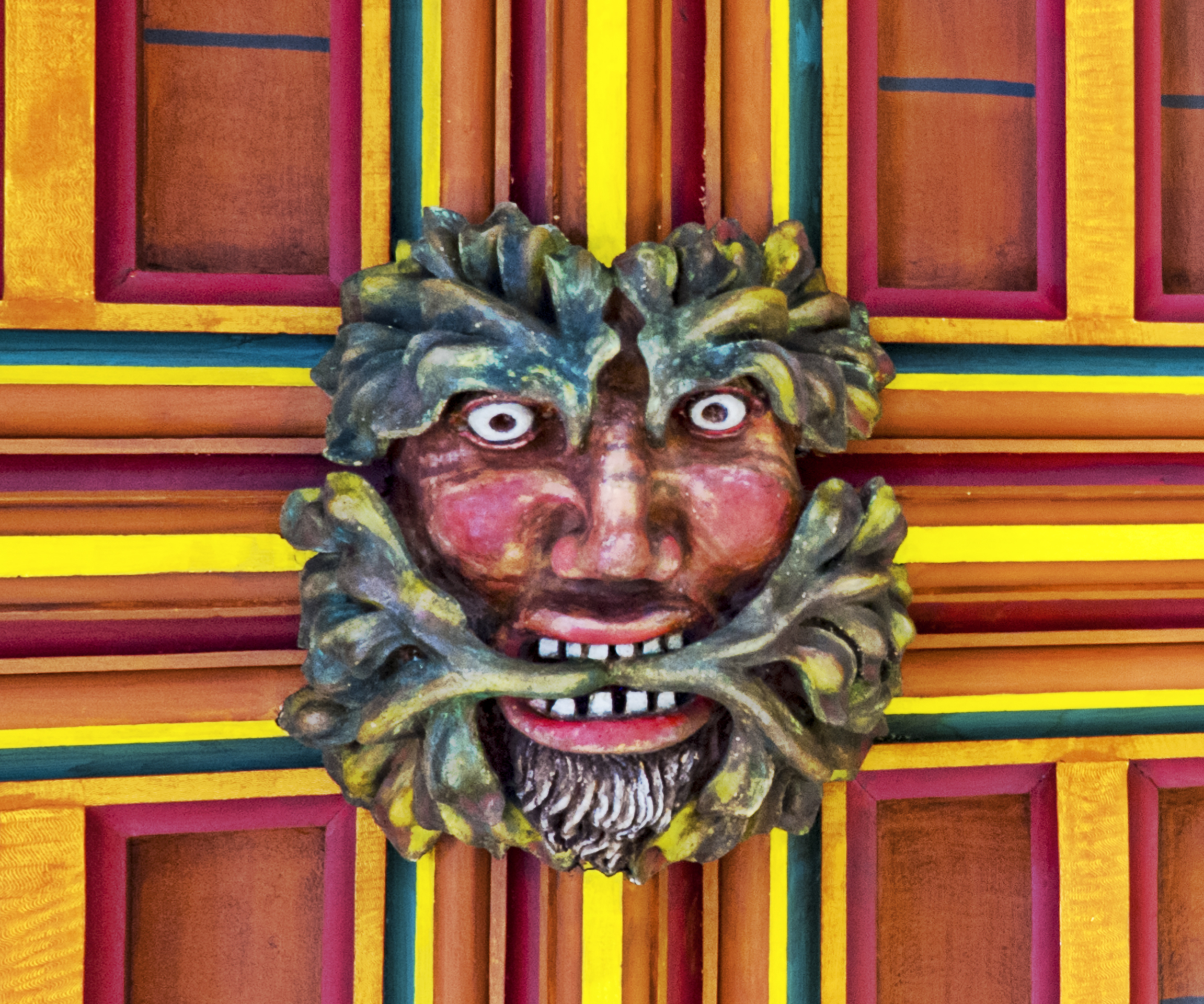
This popular motif was revived in 1840 when several brightly painted Green Men roof bosses were added to the Crossing ceiling. This was probably influenced by architect Lewis Cottingham who was in charge of Cathedral renovations from 1825 – 1840. Medieval themes were popular with the Victorians, influencing not only contemporary visual arts but also literature.

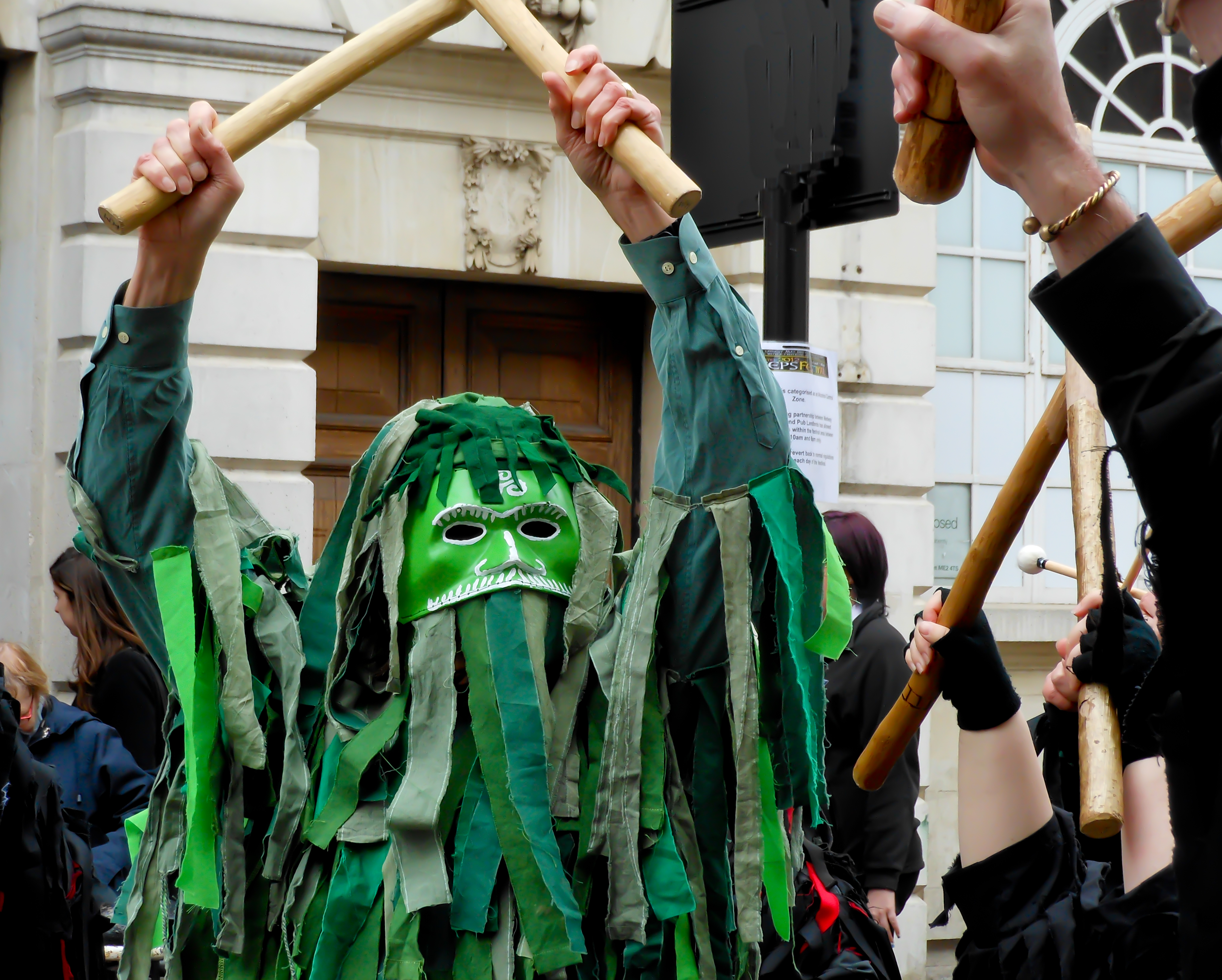
GM-DSCN1821Another character which is closely related to the Green Man carvings is the character of ‘Jack-in-the-Green’ which regularly accompanies Morris dancers during May Day celebrations. Since 1980, Rochester has hosted its own popular version of these celebrations called the Sweeps’ Festival.

Theories as to the origins and meaning of the Green Man are as numerous as those relating to UFO’s and alien life-forms. Perhaps it is its mystery that has turned this motif into such a popular metaphor for so many cultures. In fact, it is the central theme for a story entitled ‘Jack’; one of a selection of short stories inspired by Rochester Cathedral and its treasures which appear in my new book Barley Bread and Cheese.

When I gave a public reading of ‘Jack’, one of the audience told me that he knew a storyteller who had set himself the task of counting all the stories relating to green men. So far, he said, some 83 had been recorded. That must mean that my story is number 84.

So, in 20th century astronomical parlance, would that be LGM-84?

Additional links and information:

Click here for Barley Bread and Cheese

Click here for T. Thurai’s website

Click here for Rochester Cathedral, UK

Click here for Pulsars

Click here for Victorian medievalism (An article by Megan Morris, Rochester University, USA)

Click here for Rochester Sweeps’ Festival

Posted in Uncategorized | 6 Comments

Truth or dare: the medieval ordeal

DSC_0415Finding a title for a book can be surprisingly difficult. Finding the right name for my first book The Devil Dancers was a protracted agony. It took hours of jotting names on scraps of paper and pestering friends for their opinions. As time progressed, my jottings drifted off the desk and hid behind the radiator and friends avoided my increasingly frantic phone calls.

In desperation, I consulted the Internet – today’s equivalent of the Delphic oracle – paying a visit to Lulu’s Titlescorer site which estimates the potential popularity of your title as a percentage. It is an intriguing pastime but not very helpful for cheats like me who quickly learn how to increase their score by changing the parameters rather than their title!

It turned into an ordeal that took weeks to resolve.

Not so my second book. The title Barley Bread and Cheese simply presented itself as I was researching background for one of the short stories that have been inspired by Rochester Cathedral and its treasures.

This particular treasure consisted of an ancient book – the Textus Roffensis – written by a 12th century scribe who lived in the priory of St Andrew, then adjacent to the Cathedral.

While the Textus is some 900 years old, its contents are even more ancient. These include one of the most complete sets of Anglo-Saxon laws, some dating back to the early 7th century and the reign of Kent’s first Christian king, Aethelbert.

I was drowsily trawling through a list of these laws when I came across a section entitled ‘Iudicia Dei’ or the Judgements of God. These relate to various ordeals used as a primitive truth test in criminal cases.

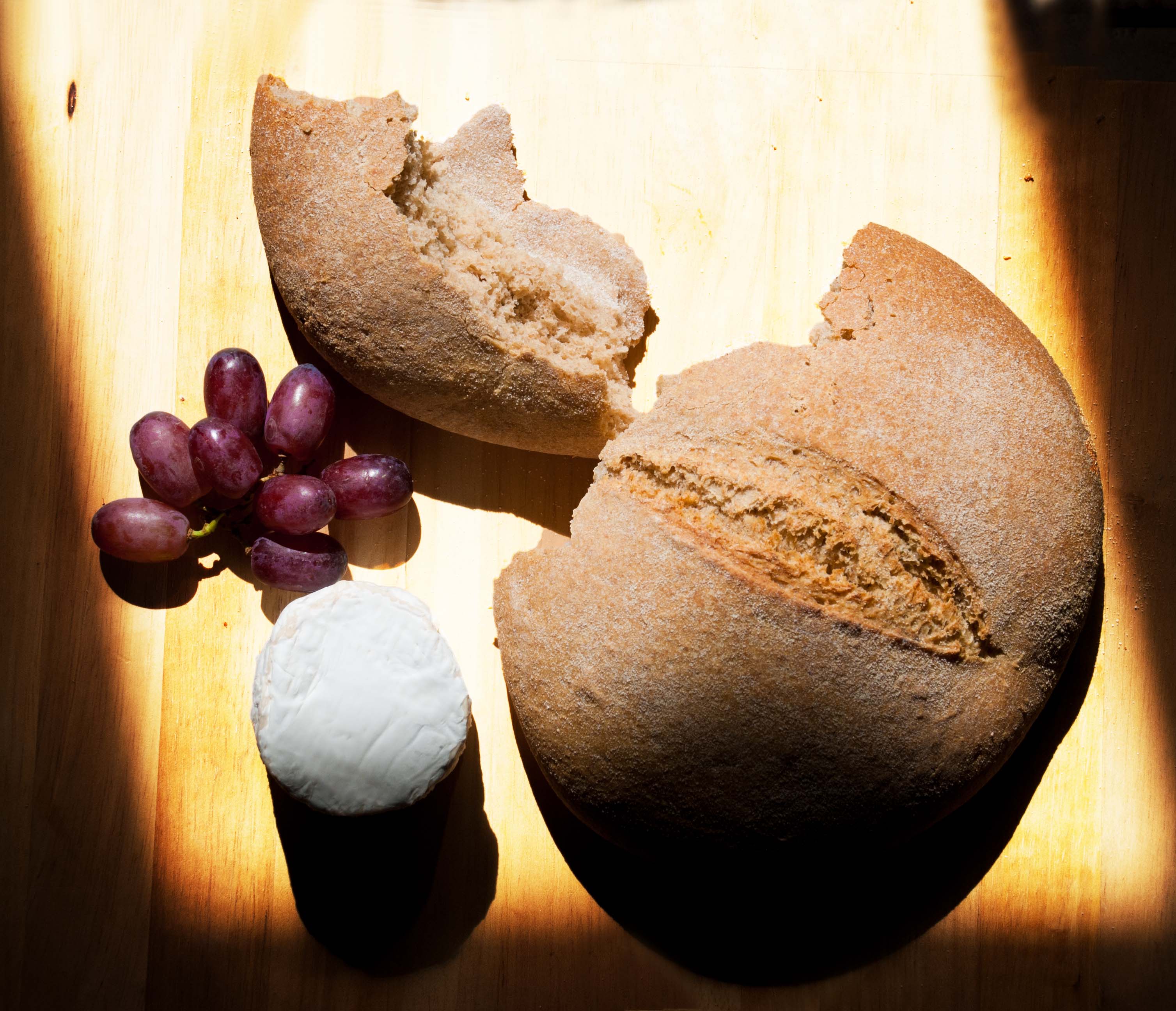
They included: the Exorcismus aquae – the ordeal of boiling water in which the accused was required to immerse his arm in boiling water; the Exorcismus ferri in which the accused was required to carry a quantity of red-hot iron and the Exorcismus panis, an ordeal in which the accused had to eat a portion of barley bread and cheese.

Wait a minute!

How could barley bread and cheese constitute an ordeal? Despite their brutality, there was a kind of cruel logic to the other ordeals. But bread and cheese! What kind of test was that?

Intrigued, I began to dig a bit deeper. I discovered a number of scholarly works by both lawyers and historians that mentioned the ordeal of barley bread and cheese. Initially, a number of points emerged upon which all seemed to agree.

In Anglo-Saxon times, the ordeal of barley bread and cheese was called corsned. It appeared to consist of an ounce of bread and an ounce of cheese (possibly made from ewes’ milk) which underwent some kind of religious ceremony before being administered to the accused.

But who exactly was the recipient of this rather mild sounding ordeal? Was it really an ordeal or a convenient sham? The commentators could not agree and various conflicting theories emerged.

Some writers suggested that it was a get-out-of-jail card for clergy accused of a crime. Others countered with the story of a famous layman, Earl Godwin the father of King Harold (of Battle of Hastings fame).

Earl Godwin had been accused of killing his own brother. He opted for the barley bread and cheese ordeal and, being somewhat over-optimistic, declared: “May this bread choke me if I am guilty!”

What happened next provided a salutary warning to anyone viewing the Exorcismus panis as a safe option.

Earl Godwin took one mouthful of the bread, choked and dropped dead!

Apparently, medieval lawgivers believed that the angel Gabriel was responsible for administering justice through this ordeal, touching the throat of the guilty party and causing them to choke.

Experiencing some difficulty with this theory, some contemporary historians have offered alternative solutions ranging from the psychological to bacteriological. Fear or a bad conscience might make you confess, rotten bread could make you ill. But stress and bad hygiene are peculiarly modern concepts and, to my mind, neither offers a satisfying solution to this puzzle.

I was as unconvinced by the modern theories as the medieval ones. The enigma of the barley bread and cheese ordeal nagged at me for months.

However, it was only after the text of the book had been ‘put to bed’ that a new theory emerged from a discussion with my wise 92 year-old mother.

As we were discussing illustrations for the story Barley Bread and Cheese, my mother reminded me that ears of barley differ from wheat in that each grain has a quiff of sharp spikes.

Could this be the key to that apparently innocent ordeal? Was a handful of unrefined, prickly grains of barley introduced into the ordeal bread?

It was the reverse of the Christmas pudding principle where the lucky person finds a sixpence randomly dropped into the mix. In this case, did the ordeal-taker risk swallowing a mouthful of tickly grain which would cause him to cough and, in extreme cases, choke?

We shall probably never know.

But in my case at least, the ordeal of barley bread and cheese has proved a positive experience. It has spared me another ordeal: that of finding a title for my book!

Additional links:

Barley Bread and Cheese (Amazon) click here

The Devil Dancers (Amazon) click here

T. Thurai’s website click here

Lulu’s Titlescorer site click here

Rochester Cathedral click here

Medway Archive click here

Posted in Uncategorized | 1 Comment

A Curious Turn of Events

Wheel

Wheel of Fortune wall painting, Rochester Cathedral, Kent

It is funny how despite your best plans, fate derails you. You can be racing along what appears to be a single-track when suddenly you are led in a totally different direction. That’s what happened to me with my latest book.
I was half-way through the draft of my second novel – a World War II story set in a remote part of the British Isles – when I became side-tracked. I had already lost steam, having had to put writing aside in order to promote my first book The Devil Dancers.
I find the whole PR process tiring and tedious. Nothing is more soul-destroying for a writer than the black art of publicity. For one thing, it takes up so much time. For another, it requires enormous input for minimal returns. There can be nothing more counter-productive to creativity than focussing on sales and column inches.
I was in a dog-tired, depressed state of mind when I settled down to watch the BBC’s interpretation of Dickens’s unfinished novel The Mystery of Edwin Drood. It is a work that I find intriguing for a number of reasons.
Firstly, it was Dickens’s last work. You can literally see where he put the pen down before suffering the massive stroke that killed him a few hours later. It is a very poignant connection with the writer that bridges the 143 years that divide him from the reader.
Suddenly, you are at his side, looking over his shoulder with the horrible presentment of hindsight; although Dickens himself cannot have known that the sentence at which he put down his pen was to be his last. It is one of the rare occasions in a book when the reader knows more than the writer. We know what happened next, although Dickens did not.
Of course, what we do not know is how The Mystery of Edwin Drood would have ended. Even in death, Dickens created a new genre – the detective story which requires the reader to supply the ending. Many writers have also offered their own solution to the mystery, including Gwyneth Hughes who wrote the script for the BBC’s 2012 production.
However, what really intrigued me was Dickens’s reference in Edwin Drood to Ceylon (now modern Sri Lanka). It struck me as a rather unlikely reference at a time when the British Empire stretched halfway across the world and there were far more obvious jewels in its crown, such as India.
Yet this reference to Ceylon struck a particular chord with me, for it was the setting – albeit in the 1950s – of my novel The Devil Dancers. I had spent nine years on that book, researching every aspect of the country, its culture and convoluted politics. For nine years, I ate, slept and breathed Ceylon – I still do – and I wondered what had inspired Dickens to refer to it.
It was that tiny, niggling question that led me to Rochester in Kent. Re-named Cloisterham by Dickens, Rochester – and, in particular its beautiful medieval Cathedral – provided the setting for Edwin Drood.
In an extraordinary twist of fate, Rochester Cathedral will shortly host the official launch of my second book Barley Bread and Cheese, a collection of short stories inspired by the Cathedral and its treasures.
As launch-date approaches, I’m going to share some aspects of that journey with you. It’s a roller-coaster and there will definitely be some white-knuckle moments. But it’s also hugely exciting. So get on board and hold tight!

Posted in Uncategorized | 2 Comments