The Sissinghurst view of World War II

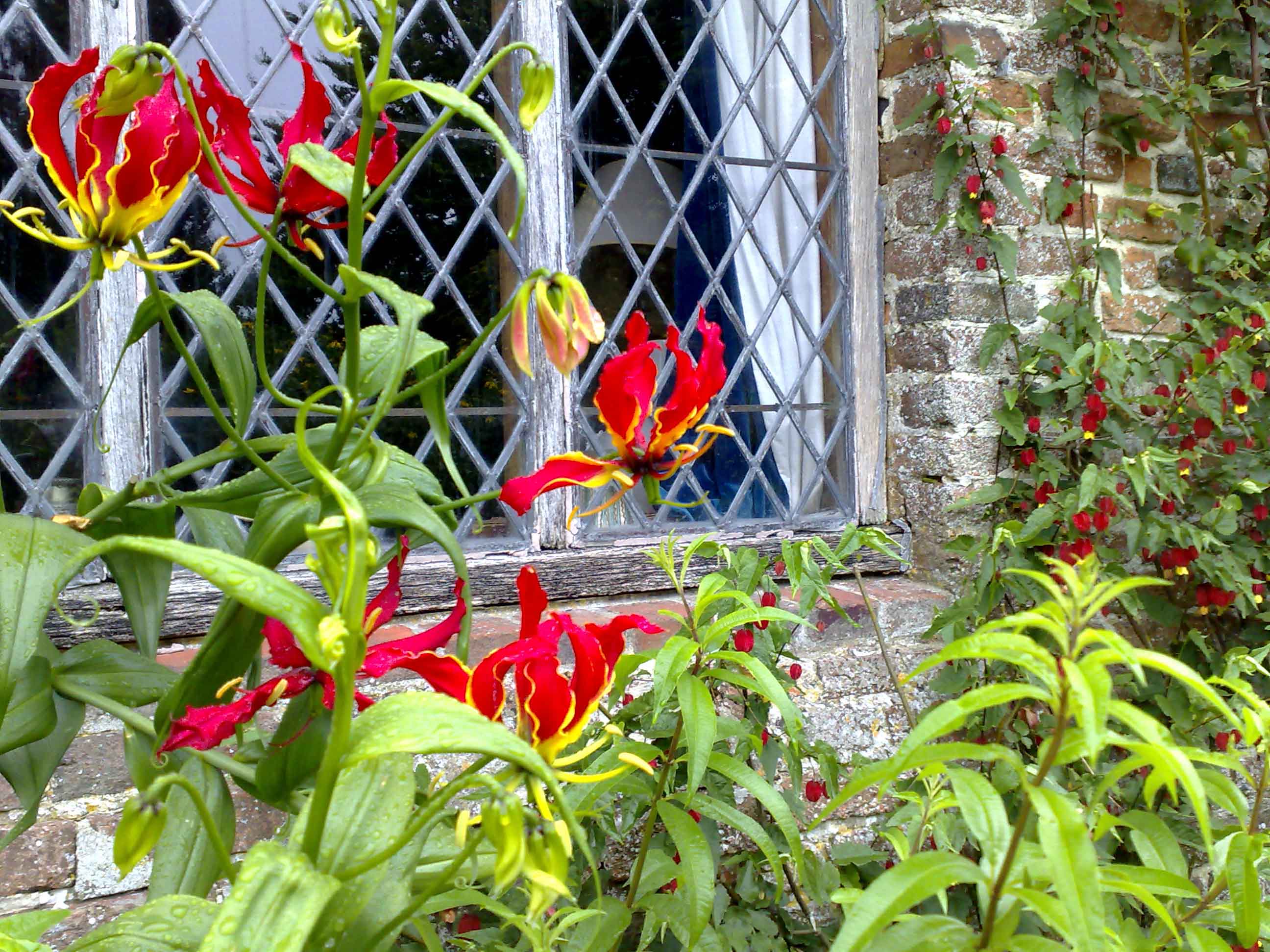
A window on the world: a detail from Sissinghurst gardens

A window on the world: a detail from Sissinghurst gardens

I recently read a Tweet from a bookseller which asked readers if they had adopted a book recently. It was one of those simple, but leading questions that started me thinking.  Yes, I thought. I have ‘adopted’ quite a few literary strays – most discovered lurking on the shelves of second-hand shops.
Yet these have turned out to be some of the most fruitful and interesting reads – particularly for an omnivore like me who is constantly searching for new sources of information for my own writing.
My latest acquisition is ‘Diaries and Letters 1939 – 1945‘ by Harold Nicolson who formed one half of the creative – and somewhat eccentric – marriage with Vita Sackville-West.
This has proved a rich source of insights as Nicolson served in the Ministry of Information and so got to observe the workings of wartime Government, especially Churchill whom he greatly admired.
There are also intriguing references to lunches with Guy Burgess and, on 29th June, 1940 an ironic comment that: ‘Guy Burgess comes to see me, and I tell him that there is no chance now of his being sent to Moscow.’
Set against this are Harold’s letters to Vita whom he clearly loved dearly although he accused her of having a dual personality: ‘The one tender, wise and with such a sense of responsibility. And the other rather cruel and extravagant.’
This reference to Vita’s cruelty and extravagance may well have related to her long-running affair with Violet Trefusis during which the two women eloped to France and Vita escorted her lover dressed as a man. Nicolson followed them and finally persuaded Vita to return home.
Ironically, Nicolson’s letter, dated 31st March 1941, crossed with one from Vita informing him that she had ‘just had the most awful shock: Virginia has killed herself.’
This, of course, was a reference to the writer Virginia Woolf who had been Vita’s close friend and lover. Nicolson’s notes record how he raced home to Sissinghurst to comfort Vita although neither of them spoke of the terrible event.
He also gives poignant details of a visit to Virginia’s husband, Leonard Woolf and how “The house was full of his flowers, and all Virginia’s things lying about as usual.”
Nicolson provides a painful and vivid account of a newly-bereaved home as well as the fact that, at first, Virginia’s body could not be found although it was assumed that she had drowned herself.
On a lighter note, his writing offers revealing – and often humorous – insights into the Nicolsons’ home at Sissinghurst in Kent where Harold and Vita created a world-famous garden.
They appear to have had a friendly relationship with their tenant-farmer Ozzy Beale whose main concern was the prospect of enemy planes landing in his wheat.
My favourite image from this intriguing book? That of a sentry patrolling the tower at Sissinghurst silhouetted against the night sky: ‘In a steel helmet and rifle he looks most picturesque in the moonlight over the parapet.’

Posted in Uncategorized | Tagged , , , , , , | 1 Comment

A Neapolitan Christmas – in Kent

DSCN2431-2

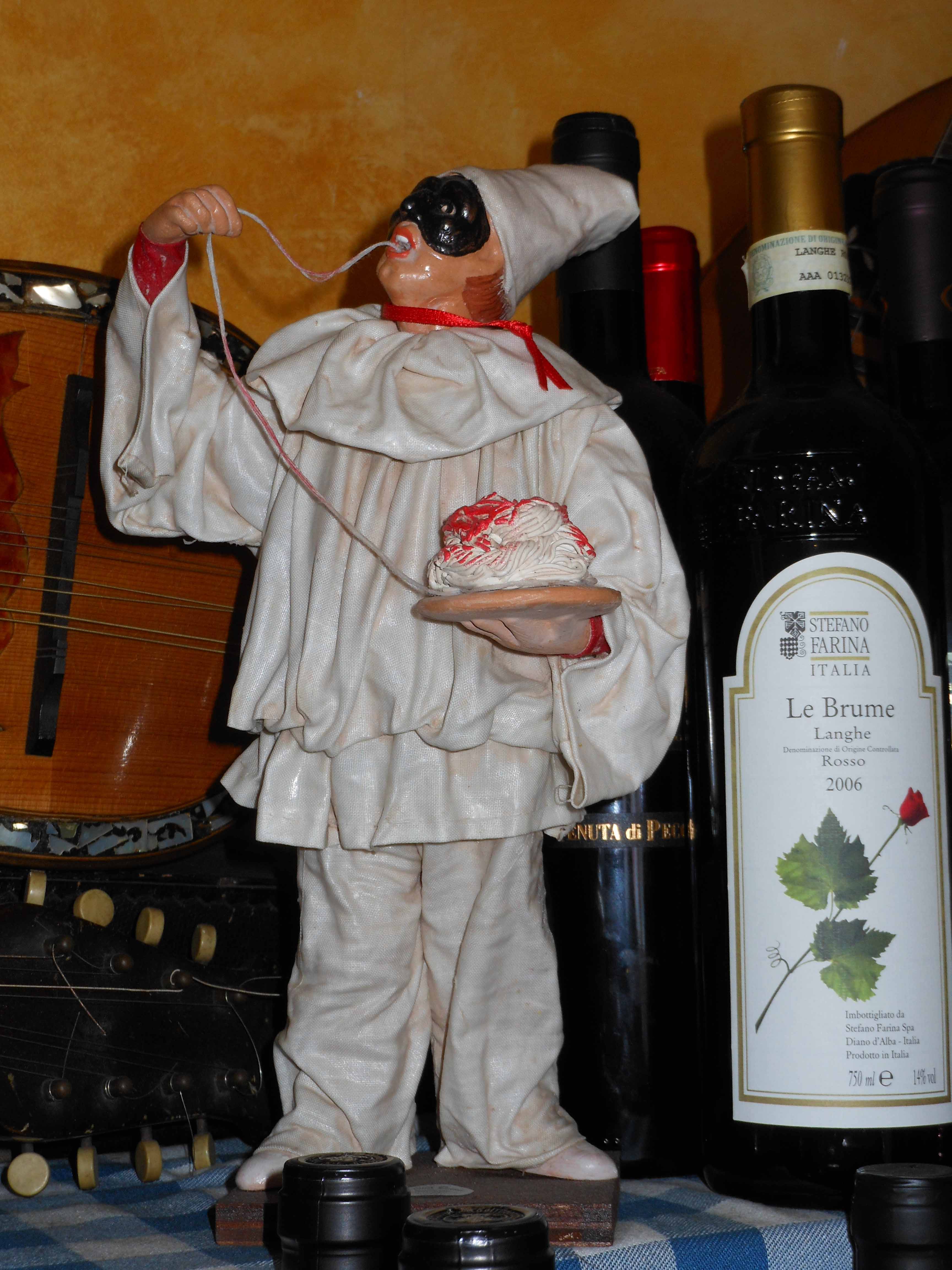
A taste of Naples: Pulcinella, a traditional Neapolitan character, samples the cuisine at Il Vesuvio

An extraordinary adventure began 17 years ago when I first met my friend Maria. I had been planning to go and work in Italy and learn the language but, instead, Italy – or rather Naples – came to me.

Introduced by a colleague at work, Maria and I hit on a plan to improve our knowledge of each other’s languages. We would meet for lunch, dividing the time into two equal sessions; one for English, the other Italian.

It worked perfectly. It also introduced Maria to some of the idiosyncrasies of the English language. For instance, the use of the word ‘Sorry’ when no apology is intended. In the highly-respected department store in Tunbridge Wells where we met for lunch, ‘Sorry’” was often employed by old ladies who elbowed their way to the front of the self-service queue with the determination of an invading army.

Sorry’ also came into play when these affluent and elderly shoppers were upbraided by traffic wardens for parking their Rolls Royces on double-yellow lines. The traffic wardens never got the better of these engagements and, strangely cowed, would skulk away in search of more compliant victims.

As our conversation lessons took place at meal times, it seemed natural to talk about food. This led to stories of family and the places in which we had grown up.

I began to get a flavour of Naples: ancient, vibrant, noisy and colourful; a place with a rich culture and its own distinctive dialect where daily life had a piquancy of danger, both from the criminal underworld and the constant threat of volcanic eruption.

Soon our conversations were transferred from the coffee shop to Maria’s home, at that time a flat above the shops in Monson Crescent – a place which I had associated with food since childhood. I had once visited the shop of a family friend there. It was a grocery shop but, being in Tunbridge Wells, it was no mere purveyor of baked beans but an Aladdin’s cave filled with exotic food products. These included coffee roasted on the premises – a rarity for those days. I never forgot the crunching sound of the coffee-grinder or the wonderful aroma of freshly-ground beans.

Coffee also played a special part in Maria’s meals: the finale to wonderful dishes of home-made pasta, it was always introduced as a joke – the punch-line to one of her husband Franco’s witty stories that always caught me unawares.

These tales covered a diverse range of topics, ranging from Nelson and Lady Hamilton to Moses but they always had a single punch-line “… and Maria made the coffee!” These stories were the Italian equivalent of the Mornington Crescent game on Radio 4’s “I Haven’t a Clue”, equally addictive and always hilarious.

The coffee was made on top of the stove in one of the two-part metallic coffee-pots favoured by Italians which funnel water up from the bottom container through a small drum of coffee above. In the hands of the uninitiated, these vessels can quickly run dry and the coffee evaporate. I am always terrified that they will explode. However, in expert hands, they produce a coffee of rich, Arabic blackness and dark intensity.

I was introduced to some of the traditions of a Neapolitan Christmas, one of which has earned the city world-wide renown. This is the Cult of the Crib (Il Presepe). Since the 17th century, Neapolitan artisans, located in the city’s Via San Gregorio Armeno, have been famed for creating life-like figurines and intricate nativity scenes. A spectacular 18thc example of one of these crib scenes is now located in New York’s Metropolitan Museum. (Click here ).

Naples’ cult of the crib has also been celebrated by one of the City’s most famous writers, Luciano de Crescenzo who wrote: “Suppose that one day, you take a walk in Naples down the street called San Gregorio Armeno. That day you will end up thinking that Jesus was born around here. There is enough atmosphere to suggest that the Crib and the Nativity cult had their origins here.”

In Maria’s home, I also learned some of the culinary aspects of an Italian Christmas. I learned the difference between Panettone and Pan d’Oro and was introduced to Torrone, a type of nougat particularly popular at New Year when the streets of Naples are filled with the sound of fireworks sold – sometimes illicitly – on street corners.

Although Maria’s children, Alessandro and Barbara, are now adults living away from home, they always return at Christmas when Barbara makes another seasonal dish: Struffoli. These small balls of deep-fried pastry are sweetened with honey, piled high on plates and may be dressed with coloured sugar sprinkles, cinnamon, orange rind and candied fruits. (Click here for a sample Struffoli recipe).

Since those early days of shared conversations in Tunbridge Wells, Maria and her family have brought the Neapolitan experience to a wider – and highly appreciative – audience. They opened their first restaurant Il Vesuvio in Camden Road, Tunbridge Wells five years ago. This was followed by a second restaurant in Maidstone run by Barbara and Alessandro.

My experience of Christmas has been hugely enriched by my wonderful Italian friends. All that remains is to wish them – and you – Un Buon Natale e Felice Anno Nuovo.

Posted in Uncategorized | Tagged , , , | Leave a comment

Buddharakkita Thera: a modern kingmaker

Buddharakkitha2

Abbot Mapitigama Buddharakkita Thera

It was a personal, as much as a political, grievance that led to the death of Prime Minister Bandaranaike in 1959. The conspiracy to assassinate him was master-minded by his erstwhile patron, the powerful Buddhist monk, Mapitigama Buddharakkita Thera.

Buddharakkita was a king-maker. Chief Priest of the ancient temple of Kelaniya, he immersed himself in politics and affairs of business. He was also embroiled in a long-running court case by which he hoped to acquire direct control over the temple’s financial affairs.

As a novice at Kelaniya, he had found a patron in the person of Don Charles Wijewardene, son of the temple’s wealthy patroness and author of a pamphlet Revolt in the Temple in which he proposed that monks should resume their rightful place as advisers to lay rulers.

Don Charles came from a devout Sinhalese Buddhist family. His mother Helena had helped to restore Kelaniya Temple – once favoured by Sinhalese kings – from the decline into which it had fallen after centuries of colonial rule. He was at once a fervent Sinhalese nationalist and a supporter of the revival of Buddhism – two threads that rapidly became entwined following Ceylon’s Independence from the British in 1948.

It was probably thanks to Don Charles that the youthful Buddharakkita first encountered this new brand of political thought. It also seems likely that Buddharakkita was groomed for his future post as Chief Priest of Kelaniya by the Wijewardene family. How far they influenced his appointment to this post is unclear, but following Helena’s generous donations and bequest to the Temple, they must have felt entitled to some say in its future governance.

What is clear is that it was at Don Charles’s home that Buddharakkita met the woman who was to become his close friend, political ally and – it was rumoured – his mistress.

Vimala Wijewardene had married Don Charles after his first wife – Vimala’s elder sister – had died. She was young, beautiful and fascinated by politics. With Buddharakkita’s sponsorship, she would first become an MP, then a Cabinet Minister during Mr Bandaranaike’s incumbency.

Her loyalty to Buddharakkita would set her at odds with the Prime Minister, not only over matters of policy, but also on a more personal level. She blamed Mr Bandaranaike for failing to suppress anonymous leaflets alleging that she was Buddharakkita’s mistress.

When hundreds of Buddhist monks performed a peaceful protest outside the Prime Minister’s residence in protest against his accord with the Tamils, Vimala played a prominent role, negotiating with the besieged Bandaranaike and triumphantly announcing the abnegation of his pact to the crowd of protesters.

While Buddharakkita’s presence was not recorded, his influence was almost certainly exerted via the monks and Vimala. The highly-organised protest against an accord by which Mr Bandaranaike had sought to grant some degree of local autonomy to the Tamils bore all the hallmarks of Buddharakkita’s campaign strategy.

In 1956, the General Election had swung decisively in favour of Mr Bandaranaike thanks to Buddharakkita’s intervention. Under his direction, thousands of monks were mobilised to canvas for votes in rural areas. The result was a landslide victory.

However, political success came at a high price. Buddharakkita was later to complain that “in order to get this Party into power I have spent over a lakh” (i.e. 100,000 rupees). Financial hardship was almost certainly the motivation for the civil suit through which he attempted to acquire direct control over Helena Wijewardene’s bequest to Kelaniya temple; a source of funds which, by law, could only be accessed by the Temple’s trustees, not by its chief priest.

In short, it appears that Buddharakkita was broke. In a final attempt to recoup his losses, he invested in a shipping company whose success depended on the grant of a government contract to transport rice. His request for the contract was refused and it seems clear that he held the Prime Minister personally responsible.

Faced with financial ruin and the ingratitude of his former protégé, Buddharakkita is reported to have said of the Prime Minister: “He is of no use now; he must be driven out.”

The result was an assassination plot, masterminded by Buddharakkita, which led to the murder of the Prime Minister and the initial implication of Vimala Wijewardene. Although Vimala was eventually discharged, both Somarama Thera, the monk who pulled the trigger, and Buddharakkita were sentenced to death.

While Somarama Thera was hanged, Buddharakkita’s sentence was commuted to life imprisonment. He died in jail in 1967.

Despite his undeniable influence, Buddharakkita barely rates a mention in the history books. One can only guess why. Yet this extraordinary story is a reminder of what can happen when the close bond between religion and politics turns sour.

This is the third of three articles recently published in The Colombo Telegraph.

Additional information:
My first novel The Devil Dancers is set in 1950s Ceylon and took nine years to write and research. Further historical background can be found on the book’s website at: www.thedevildancers.com. Reviews and comments are also posted there, including the latest from Gratiaen Prize judge Professor Walter Perera of Perideniya University, Sri Lanka.

← Back

Thank you for your response. ✨

Warning
Warning
Warning
Warning

Warning.

Posted in History, Sri Lanka | Leave a comment

The Extraordinary Case of the Prime Minister’s Murder

This is the second article in a three-part series which is currently being run in the Colombo Telegraph.

Mr Bandaranaike, Prime Minister of Ceylon 1956 - 1959
Mr Bandaranaike, Prime Minister of Ceylon 1956 – 1959

On a quiet September morning in 1959, two men were waiting for an audience with an important man. Seated on the verandah of the Prime Minister’s house, Asoka Christopher Seneviratne and his uncle Stephen had come to ask for a certificate of character.
A mundane request for an insignificant piece of paper; the sort of thing used to support an application for a job or bank loan.
The man they had come to see was S.W.R.D. Bandaranaike, leader of the Sri Lanka Freedom Party, who had swept to victory three years earlier. Yet despite his electoral success, Mr Bandaranaike’s short incumbency had not been a peaceful one.
In previous months the country had been brought to a standstill by strikes and pushed to the brink of civil war by violent ethnic riots.
Yet, by 1959 peace appeared to have been restored.
Neither of the two men seated outside the Prime Minister’s home could have anticipated the momentous event that they were about to witness.
Having waited patiently for twenty minutes, they were joined by another supplicant: a Buddhist monk who seemed impatient to catch a glimpse of the Prime Minister.
Before seating himself next to the two men, the monk wandered up to the house and peered through the drawing-room window. He then settled next to Asoka and began chatting, mentioning that he worked at the Ayurvedic Hospital.
The men continued to wait. Mr Bandaranaike was late, delayed by visitors inside the house who included the American ambassador.
At last, he stepped onto the verandah where he dealt first with Asoka, directing him into the house, to his office, to write down some personal details. Asoka did not witness what happened next, although he heard it.
After sending Asoka into the house, Mr Bandaranaike greeted the monk, bowing his head in the customary salutation. The Prime Minister then began to question the monk. What had brought him to the surgery?
As the Prime Minister spoke, the monk pulled a gun from his robes and shot Mr Bandaranaike in the hand and chest. The Prime Minister cried in pain and ran into the house, followed by his attacker who fired two more shots at his victim.
Pandemonium broke out. Mrs Bandaranaike ran in from the garden and, holding her husband’s hand, tried to pull the monk away by his robes. The monk tried to escape but was tackled and brought to the ground by several men who had run to the scene, alerted by the shots.
The gun fell to the floor and a furious tussle ensued; the monk scrabbling to retrieve his weapon. Eventually, he was subdued: shot by a policeman and, apparently, sustaining a wound to the genitals – a detail which would later become the subject of a ribald song.
Although he did not die immediately, Mr Bandaranaike was mortally wounded, succumbing to gunshots to the stomach on the following day.
The murderer – Talduwe Somarama Thera – would be one of seven people charged with the Prime Minister’s assassination. It was one of the most extraordinary conspiracies of the 20th century in which the plot to assassinate a leading politician was master-minded and executed by Buddhist monks.
This plot, worthy of the Borgias in its complexity and intrigue, came from an entirely unexpected quarter: the Prime Minister’s own supporters.
Yet, although he was the assassin, Somarama Thera was merely a pawn in a much more intricate game. The real mastermind was a charismatic Buddhist monk – Mapitigama Buddharakkita Thera – whose extraordinary career reflects the bond between religion and nationalist politics in Sri Lanka. Yet it is an example that many would prefer to forget.
In Part 3: A profile of Buddharakkita Thera, his rise to power and the relationship that began with patronage and ended with murder.
Additional Information:
My first novel The Devil Dancers is set in 1950s Ceylon. Writing and researching material for the book was a lengthy project which took nine years. More information can be found on my website at: www.thedevildancers.com.

Posted in Uncategorized | Tagged , , , , , , , , , , | Leave a comment

Sri Lanka: The Unbreakable Bond

This article was first published in the Colombo Telegraph (www.colombotelegraph.com) on November 10th, 2013. It is the first in a series of three.

When I wrote my novel The Devil Dancers, I could not have predicted that the cycle of events in 1950s Ceylon which provided the historical background for my book would re-surface in contemporary Sri Lanka.

An important influence on Sri Lankan politics since Independence – which has neither been fully appreciated nor understood by the West – is that of the Buddhist clergy or sangha. This is partly due to Western misconceptions regarding Buddhism.

Shaped by notions of Zen Buddhism, a liberal dose of romantic Orientalism and the traditional separation of power between Church and State, the European perception of Buddhism is that of a purely spiritual practice, completely disengaged from the interests of the temporal world.

We are therefore surprised when confronted by the blend of political activism and nationalism which can occur within the Theravada branch of Buddhism common to both Sri Lanka and Burma.

From the western perspective, Buddhism is viewed as a uniformly pacifist, politically neutral faith. It comes as a surprise, therefore, to learn that in some parts of the world – namely Sri Lanka and Burma – there is a particular brand of Buddhism in which monks are not only politically active but have also become embroiled in activities that are aggressive, violent and sometimes criminal.

Recent TV news items from both countries have shown Buddhist monks taking an active part in attacks against minority religious groups. While Moslems have been the main target, they have not been the only one. Attacks on Christians have also been reported in Sri Lanka.

What is the reason for this? Perhaps history can help to explain.

Theravada Buddhism – the branch practised in both of these countries – has been linked either with the movement for Independence from the British (Burma) or with the post-colonial establishment of power by the majority ethnic group (Sri Lanka).

More recently, a number of extremist Buddhist groups have appeared in both countries: the 969 movement in Burma and the Bodu Bala Sena, Ravana Power and Sinhala Ravaya groups in Sri Lanka.

With the summit of the Commonwealth Heads of Government being hosted by Sri Lanka, attention is focusing once more on the disturbing reports of exactly what happened in the closing stages of the civil war in 2009. A year ago, the United Nations’ Panel of Experts stated that “[a] number of credible sources have estimated that there could have been as many as 40,000 civilian deaths”.

However, attempts to secure an international investigation into these events have so far failed. In August, Buddhist monks besieged the UN building in Colombo to protest against the UN’s proposed investigation into allegations of war crimes committed by the Sri Lankan government. Renewed calls for transparency from foreign powers could well result in further demonstrations.

While it may surprise outsiders, the politicisation of Sri Lanka’s Buddhist monks has been taking place – and gathering pace – for over a century. The first seeds were sown when, at the end of the 19th century, Buddhist monks successfully engaged in public debate with western missionaries.

Successive colonial governments had supported Christian missionaries of varying denominations to the detriment of Buddhist religious life. Government funding was provided to Christian schools, but not to Buddhist establishments. Even celebrated religious institutions, such as Kelaniya with its ties to Sinhalese royalty, were allowed to fall into abeyance.

However, the trend for re-assertion of Buddhist rights and ideals rapidly gathered momentum, particularly following Independence from the British in 1948. A high-water mark was achieved in the mid-‘50s when the country’s Buddhist establishment produced a report entitled The Betrayal of Buddhism, an assessment of how the island’s majority religion had suffered at the hands of foreign influence.

It was at this time, if not before, that Buddhism – traditionally the religion of the Sinhalese majority – became inextricably linked with Sinhalese nationalism.

In Part 2:  The story of a shocking political assassination and the monk who not only masterminded a Prime Minister’s election but also his murder. Dating back to the mid-1950s, it is a scandal that history has overlooked. Yet it provides a fascinating insight into the interdependence of religion and politics in modern Sri Lanka and shows what can happen when that relationship turns sour. 

Additional information:

My first novel The Devil Dancers is set in 1950s Ceylon and has received reviews from the Commonwealth, Russia and the USA. These, together with extracts from the most recent review by Professor Walter Perera of Perideniya University, can be found on the book’s website at: www.thedevildancers.com.

Posted in Uncategorized | Tagged | Leave a comment

Shroud-eaters, vampires and plague doctors

435PX-2In 2007, rare evidence of a ‘vampire burial’ was discovered near Venice. A 16th century skeleton was found, lying on its back, with a brick firmly wedged between its jaws.

The skeleton was identified as that of a 60-year old woman who had died in the great plague of 1576; one of three that ravaged Venice and the same one that claimed the artist Titian.

Every lover of gothic horror experienced a frisson of delight. A real vampire had been found – or, at least, evidence of an ancient belief in the ‘nachtzehrer’ or Night Waster.

And yet, the real terror experienced by those who exorcised the corpse of this 16th century Venetian woman bore little resemblance to the synthetic fear associated with the vampire genre spawned by Bram Stoker’s Count Dracula.

Stoker’s creation was endowed with an aristocratic pedigree, impeccable taste, excellent dress sense and eccentric eating habits. He was at once attractive and repellent, refined and bestial.

Yet, in truth, the vampire is a creature of mixed heritage, a cultural hybrid.

Tales of the ‘nachtzehrer’ can be traced back to the 13th century and probably originated in Poland. By the 17th century, the belief had spread throughout Europe.

Largely thanks to Stoker, it became commingled with tales of a real man who was regarded both as a monster and a national hero.

In the 15th century, Prince Vlad III ruled Wallachia in what is now known as Romania. His father had belonged to the Order of the Dragon, a chivalric order set up to protect eastern Christians from the incursions of the fast-growing Ottoman Empire. The epithet ‘Dracul’, meaning dragon, passed from father to son.

Vlad III became a national hero for his attacks on the Ottomans. However, his method of dealing with his enemies also earned him the reputation for being a bloodthirsty sadist and he acquired the nickname Tepes or Impaler. The term is thought to have been coined originally by the Turks who encountered forests of Vlad’s victims impaled on stakes.

Stoker borrowed both Vlad III’s family name and his favoured method of execution. However, with a nice touch of irony, the stake was not destined to be the vampire’s weapon, but his nemesis.

So how does Venice’s vampire burial fit in with this extraordinary blend of fact and fiction?

The Venetian skeleton with its extraordinary ‘gob-stopper’ was discovered during the excavation of a plague pit on the island of Lazzaretto Nuovo.

Originally called Vigna Murada, the island was designated a ‘lazaret’ in the 15th century: that is, a place of quarantine where ships, travellers and goods were detained in order to try and prevent the Plague reaching Venice via its trade with the Orient.

Venice suffered three devastating episodes of plague in 1347 – 49, 1575 – 77 and 1630-31. During the plague of 1575 – 7, it is estimated that some 10,000 people and 3,000 ships were kept under observation at Lazzaretto Nuovo.

Anyone diagnosed with the disease was transported to the nearby island of Lazaretto Vecchio for further isolation and treatment by plague doctors or ‘Medici della Peste’.

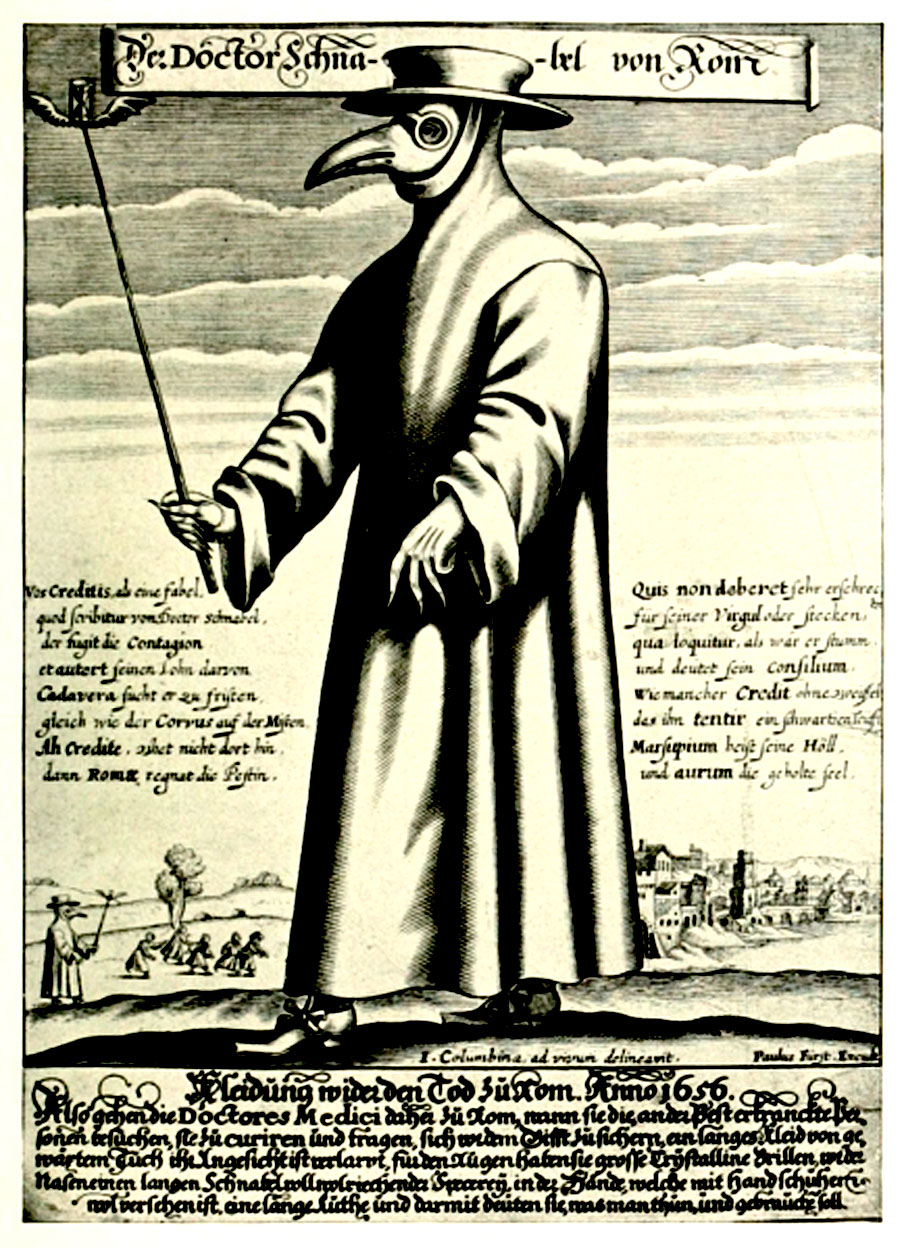
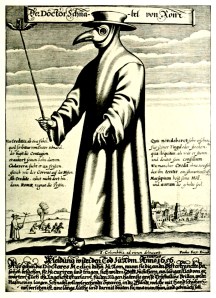
To protect themselves, these dedicated medics wore an early version of the modern ‘hazchem’ suit. Black gloves, black boots, a long black coat made of waxed cloth and a hat often shaped like a black halo. Most terrifying of all was the white face- mask with its bird-like beak stuffed with aromatic herbs to protect the wearer from contagion.

To terrified patients, the plague doctor was a portent of death; a sinister, black-robed figure of demonic aspect; an escort to the underworld.

The mask of the ‘Medico della Peste’ has since been immortalised by the Venetian Carnival and is a traditional feature in the repertoire of the City’s artisan mask-makers. Yet, even now, it has a chilling aspect.

The plague came to Venice as a scourge and has been blamed for the city’s eventual decline. Yet, ironically, it was also responsible for some of its most beautiful buildings. Divine intercession was sought and vows taken in return for deliverance. The result? The beautiful plague churches of Il Redentore and Santa Maria della Salute.

The loss of life from the epidemics was immense. Tens of thousands of plague victims were buried in mass graves. In 2006, a team of archaeologists began the immense task of excavating the plague cemetery on Lazaretto Nuovo. It was as a result of this work that the ‘vampire’ skeleton was found.

Science can now explain many of the theories surrounding the ‘undead’. During times of plague, old graves were re-opened to bury hundreds of new corpses. It was often noted that decaying cadavers appeared to have ‘eaten’ through their shrouds: the result of bacteria from the mouth decaying the cloth. The bloated corpses looked fat and well-fed and the juices being exuded as a result of decomposition made them look as if they were bleeding from the nose and mouth.

So, the myth of the shroud-eaters was born. They were believed to rise from their graves to infect the living, spreading deadly contagion. To stop them, their mouths were filled with soil or rubble; the theory being that they would be unable to chew and eventually starve.

This is mirrored in modern literature. The ‘contagion’ of vampirism is spread by the vampire’s bite while Stoker’s hero Van Helsing stuffs a vampire’s mouth with garlic in an attempt to stop it eating.

Archaeology has now laid the myths to rest. According to Matteo Borrini, Director of the Lazzaretto Nuovo excavation, old accounts of vampires inhabiting graves were actually descriptions of decomposing bodies – a process only observed when graves were re-opened in unusual circumstances such as plague epidemics.

So, if you hear something going ‘bump’ in the night at Halloween, take comfort. Whatever it is, it will not be a vampire.

Further information:

For mythology and magical realism in a modern novel, see The Devil Dancers at: http://www.thedevildancers.com/

Bibliography:

Plague Vampire Exorcism by Samir Patel – Archaeology Archive, Archaeological Institute of America http://archive.archaeology.org/online/features/halloween/plague.html

Lazzaretto Nuovo (Italian and English) http://www.innvenice.com/Lazzaretto-Nuovo.htm

Plague Doctor Costume http://en.wikipedia.org/wiki/Plague_doctor_costume

Venice’s plague churches:

Il Redentore (designed by Palladio): http://www.architecture.com/librarydrawingsandphotographs/palladio/andreapalladio/palladiosbuildings/palladioschurches/ilredentore.aspx

Santa Maria della Salute: http://www.architecture.com/LibraryDrawingsAndPhotographs/PalladioAndTheVeneto/PalladiosLegacy/BaldassareLonghena/Longhena1.aspx
Posted in Fiction, History, Magical Realism, Myth | Tagged , , , , , , , , , , , , , | Leave a comment

Survival against the odds: Canterbury’s medieval guest-house

DominicanPriory3Medieval pilgrims have featured prominently in my writing this year.
First, there was William of Perth, the mysterious Scottish baker who shot to fame as Rochester’s patron saint and provided the inspiration for my story The Baker’s Boy. The research for this story also provided material for my first blog on medieval pilgrims.
Now, with a sense of déjà vu, I am about to give a talk on writing historical fiction in Canterbury’s Dominican Priory.
The building currently known as the Dominican Priory sits on the west bank of the River Stour. It represents only a fragment of what was once an extensive complex of monastic buildings, the greater part of which was situated on the opposite river bank.
Today’s ‘Dominican Priory’ was originally a guest-house. Run by the Dominicans, it served the needs of pilgrims who travelled to Canterbury from both Britain and Europe in order to visit the shrine of St Thomas Becket in the Cathedral.
It is ironic that the means to build the Priory was provided by the grandson of Henry II, the king responsible for Becket’s demise.
Young Henry III came to the throne when he was nine. Like other child-monarchs who emerged from the shadow of multiple regencies, he had to contend with powerful nobles who had thrived in the absence of royal authority.
Having taken the reins of power in 1234, Henry soon ran into trouble with the nobility. From 1237, objections were expressed, first to the influence of Henry’s Savoyard relatives, then to his sister’s marriage to the man who would become the king’s fiercest opponent, Simon de Montfort.
Perhaps it was this atmosphere of increasing tension and unease that prompted Henry to make a generous gift to the Dominicans: a large plot of land within the safety of Canterbury’s city walls and £500 to build a church and priory.
The Dominican guest-house was originally located on an island with two small wooden bridges spanning the River Stour which provided access to the Priory’s refectory on the opposite bank.
However, following Henry VIII’s dissolution of the monasteries in 1538 – which also resulted in the destruction of Becket’s shrine – the guest-house suffered a drastic decline in fortune.
Without pilgrims, it no longer had a purpose. The former guest-hall, once a haven for the faithful and penitent and, no doubt, a lucrative source of income for the Priory, was stripped of its identity. Even its unique island status was lost when the small, encircling branch of the river was in-filled.
Over succeeding centuries, it has fulfilled a variety of functions. Having served Canterbury’s Huguenot weavers, it became a private home in the 18th century then, in 1905, a furniture store. Gradually, it declined and fell into ruin.
It is thanks to the dedication and generosity of Donald and Poppy Beerling that this unique building was saved and restored – a work that began in 1969.
By this time, most of the original Dominican Priory had disappeared, with the exception of the guest-house and the refectory on the opposite bank.
The Beerlings’ vision and tireless hard-work rescued the guest-house from certain oblivion and the fate originally intended for it by Henry VIII in 1538.
The flint-covered building with its leaded windows and steep, sloping roof sits beside the river, a timeless and tranquil spot which contrasts with straight-edged modernism of the new Marlowe theatre. Inside, the old guest-house retains some of its original stained glass as well as its massive oak beams, dyed black by the smoke from medieval fires.
Although privately run, the old guest-house has been put to public use, serving as a community hall and events venue for a variety of functions, including two Saturdays of creative writing workshops arranged by the SaveAs Writers group as part of this year’s Canterbury Festival Umbrella.
Sadly, Donald Beerling passed away in August, some 18 months before the old guest-house’s 700th anniversary celebration. From December, the building will close indefinitely while the charity that now runs it considers its future.
Hopefully, that future will once more be one of public service: the original function of the guest-house that the Beerlings understood so well.
This wonderful building is a tribute to an extraordinary couple who devoted themselves whole-heartedly to the rescue of a unique piece of British history.
All those of us who love our heritage owe them a huge debt.

Additional Information
The creative writing workshops taking place on Saturday 26th October include: poetry, historical fiction, technology for writers, and blogging. For more information, click here
For more information about SaveAs Writers group, click here
For more information about T.Thurai’s books The Devil Dancers and Barley Bread and Cheese, click here

Posted in Uncategorized | Leave a comment

Pity the Pilgrim: the medieval tourist trade

ImageIf you are packing your bags for a summer holiday, spare a thought for the medieval pilgrim. In most cases, the modern holiday from hell amounts to little more than a long queue at the airport or a hotel resembling Fawlty Towers. If you fall sick there will be pharmacists, doctors and hospitals on hand to treat you.

If your car breaks down or you lose your camera, you will be covered by insurance and receive a replacement. However fraught your holiday, you can usually expect to return home safely after a relatively short period of discomfort.

To fund your holiday, you probably saved a little every month over a year. Even if all goes wrong, your trip is a disaster, your hotel is half-built and you cannot claim compensation, you would probably not expect to lose everything you own. Not so the medieval pilgrim.

In the Middle Ages, some pilgrims would sell everything they had to fund a trip to a holy place. Why? In some cases, the trip was prescribed by the church as penance for a crime. In others, pilgrims were motivated by piety or, in the case of wealthier travellers, by a desire to see the world.

Chaucer’s Wife of Bath is described as a wealthy widow “five times at church door had she been”. The wealth accumulated from her various marriages obviously funded her love of travel. We are told that “Thrice at Jerusalem had this dame been … And she had gone to Rome and to Boulogne, To Saint James in Galicia, and Cologne …”.

The travels of this fictitious character are, in some degree, mirrored by those of the 15th century mystic Margery Kempe. Born into a Norfolk merchant’s family, Margery married a local tradesman and, for a while, ran her own businesses of brewing and milling.

However, Margery’s religious visions prompted her to make numerous pilgrimages. Her first trip abroad lasted two years (1413 – 1415) and reveals a staggering itinerary which took in the Holy Land, including Jerusalem and Calvary; Constance; Venice; Assisi and Rome.

Two years later, Margery was off again to visit the shrine of St James of Compostella in Spain. At a later date, she accompanied her daughter to Danzig and was blown off course to Norway. When she finally reached Germany, Margery visited sites with holy relics at Wilsnack in Brandenburg and Aachen, returning home via Calais to London.

While Margery is said to have lived off alms on her trip to the Holy Land, it is doubtful that such a wealthy woman was deprived of all of life’s comforts. Perhaps, like the Wife of Bath, she travelled on horse-back at least part of the way.

However, life was very different for poorer pilgrims who were obliged to travel on foot. Unlike the wife of Bath who wore fine clothes, including red stockings and soft leather shoes, they would have worn what amounted to the pilgrim’s uniform: a hat with a broad brim; a long, rough woollen tunic called a sclavein; a leather pouch or scrip in which they carried their money and a heavy staff tipped with metal for protection against attacks from wild animals or robbers.

The only kind of insurance that these travellers had was a blessing from their priest before setting out. If they were sensible, they would have travelled in a large group and, if possible, spent the night under cover. Monasteries were supposed to offer free board and lodging to travellers (only the wealthy could afford inns) and beds were shared. But such Spartan hospitality was not always available at the end of the day.

Sickness, bad weather or treacherous roads could easily slow a journey and pilgrims would have had to rely on the kindness of local people for shelter. A hay-barn would have seemed like luxury compared to a damp bed under a hedge or a tree dripping with rain. Then, of course, there were robbers and bandits who stalked the woods and countryside and who even infiltrated unsuspecting groups of pilgrims, waiting for a chance to ambush them on the open road.

Even when they reached their final destination, pilgrims would have had to endure further physical discomfort, suffering fatigue, hunger and extremes of cold or heat as they waited in long queues to visit a popular saint’s shrine which they may have approached up a flight of steps on their knees.

Yet, in some ways, medieval pilgrims resembled their modern counterparts. They, too, had an insatiable taste for trinkets and souvenirs. The seasoned pilgrim would decorate his broad-brimmed hat with small metal tokens. Each badge had a design which signified a particular shrine, for instance: a scallop shell for Compostella, a palm for the Holy Land, a set of keys for Rome.

Shrines in England also had their own distinctive tokens, for example: a depiction of Becket’s shrine (Canterbury); a portrait of St Bridget (Syon Abbey); St George fighting the Dragon (Windsor).

And, for the folks back home, holy water could be transported in small pewter flasks called ampullae.

In their desire to see the world, to experience different cultures and to collect keepsakes, medieval pilgrims were not so different from us. However, the hardships endured on their travels were far greater. If your holiday does not quite live up to expectations, just be thankful. Your discomfort is only likely to last two weeks. Theirs could last for two years!

Additional information

William of Perth, a hapless pilgrim who became Rochester’s patron saint, was the inspiration for ‘The Baker’s Boy’, one of the short stories in my new collection Barley Bread and Cheese. For more information, click here

For information about my novel The Devil Dancers and other writing, please click here to visit my website

Posted in Uncategorized | Leave a comment

Rochester’s Medieval Mystery

DSC_0383-b-72dpiWhen researching medieval pilgrims for my story The Baker’s Boy, I was struck by the many facets of what resembled an early form of the tourist industry.

The subject of my research was William of Perth, an obscure Scottish baker who, having met an untimely death outside Rochester, became not only its patron saint but whose shrine also provided a much-needed source of income for its Cathedral and Benedictine priory.

What fascinated me about William was how someone who would probably have been regarded as a complete foreigner about whom little or nothing was known, was catapulted to saintly stardom and whose shrine became a ‘must-see’ for pilgrims.

Very little is known of William’s former life and what we have dates from a source printed some 300 years after his death. However, the reasons underpinning his celebrity probably have something to do with the rise of another medieval saint, Thomas Becket.

Formerly Chancellor of England, Becket had become Archbishop of Canterbury and famously opposed King Henry II’s attempt to subject ‘criminous clerks’ to the rule of secular law. Whether or not Henry actually ordered Becket’s death or, as he claimed, his words of frustration were wrongly interpreted as a signal for decisive action, Becket was subsequently murdered in Canterbury Cathedral by four of the king’s knights.

Following his death in 1170, Becket’s tomb rapidly became a focus of pilgrimage – a trend which can only have been strengthened by his canonisation in 1173. Although this was not the quickest canonisation – that distinction belongs to St Anthony of Padua who was canonised in under a year – Becket was, nonetheless, something of a ‘fast-track’ saint.

What probably accounted for Becket’s popularity was that he was contemporary, not a half-forgotten Saxon or Roman saint, but a man famous in his lifetime both for his status and his long-running conflict with the king.

Becket’s brutal death shocked a nation and, almost overnight, his tomb became a place of pilgrimage. The popular reaction to his death might well have resembled the extraordinary outpouring of grief on the death of Princess Diana.

Becket’s death had a profound impact on both the Cathedral and town of Canterbury, attracting pilgrims from all over Britain and Europe and becoming the focus of an early and lucrative form of tourist trade. It has been estimated that, in one year alone, some 100,000 pilgrims visited Becket’s shrine. They brought not only their devotion, but also their money.

To illustrate the wealth generated by medieval shrines, here is a contemporary account of Becket’s tomb: “the shrine appeared, blazing with jewels and gold; the wooden sides were plated with gold, and damasked with gold wire, and embossed with innumerable pearls and jewels and rings, cramped together on this gold ground.”

During the 12th century, Rochester Cathedral was confronted with serious challenges which could have resulted in its permanent decline. In 1137 and 1179, it suffered two devastating fires. Then, in 1199, Pope Innocent III imposed an unprecedented tax of one fortieth of all income on the clergy in order to finance a crusade. In the same year, a note in a contemporary text records an investigation into Rochester Priory’s debts.

It seems clear that Rochester was in financial difficulties.

In 1201, the untimely death of an unknown pilgrim just outside Rochester could well have saved the Cathedral and Priory from economic catastrophe.

Was the saintly cult of William of Perth modelled on that of Becket? It certainly seems likely.

Without doubt, William’s shrine was extremely popular. The Pilgrim Steps that led to his shrine have been so worn down by pilgrims that they are now preserved under a wooden frame. The funds raised from medieval pilgrims almost certainly contributed to the renovation of the Cathedral.

In this respect, it is tempting to see William’s career as contemporary medieval saint running in parallel with that of Thomas Becket. Sadly, their shrines both shared the same fate, being destroyed c.1538 as a result of Henry VIII’s dissolution of the monasteries.

Additional Information

The Baker’s Boy is one of a collection of stories inspired by Rochester Cathedral, its history and treasures which appears in T. Thurai’s new book Barley Bread and Cheese. Click here

To learn more about Rochester Cathedral, click here

For T. Thurai’s website, click here

Posted in Uncategorized | Leave a comment

A Tale of Little Green Men

GM-0061In one of its most ambitious graphics yet, Google recently displayed an animated title with a humorous portrayal of a flying saucer piloted by a tiny spaceman. This commemorated the 66th anniversary of the Roswell incident in New Mexico in which the crash landing of an Unidentified Flying Object spawned numerous theories relating to alien visitors.

It is probably no coincidence that, when the first pulsar was spotted some 20 years later in 1967, regular flashes of light from deep space became known to astronomers as LGMs – an acronym for ‘Little Green Men’.

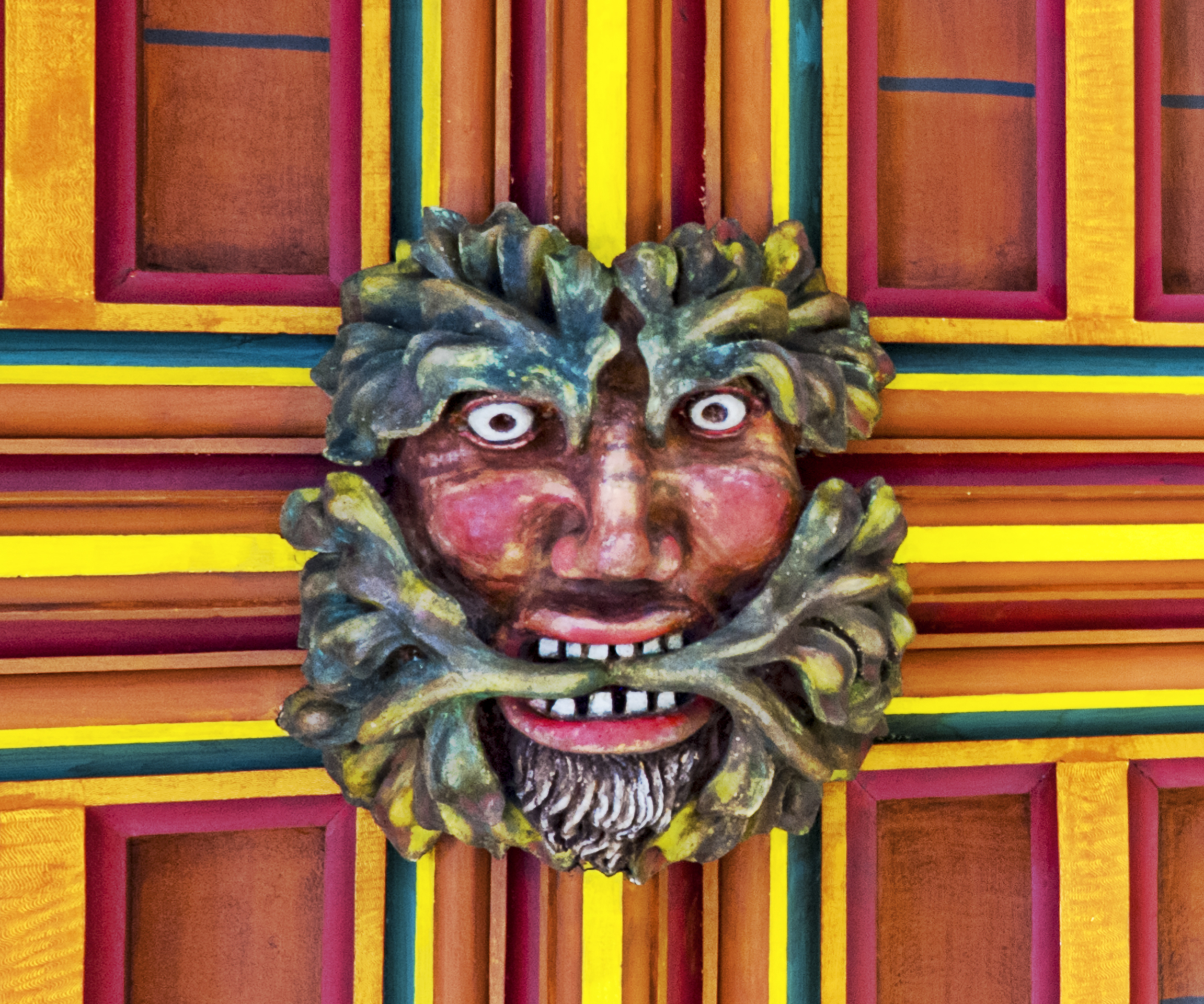
But you do not have to search outer space to find LGMs. They have been living here among us for centuries – and many have settled in churches. At least 25 reside in Rochester Cathedral.

The origins of these little green men are almost as mysterious as those of the supposed aliens at Roswell. Carvings of leaf masks and foliate heads can be traced back hundreds of years, springing up in ancient Rome, Iraq, Nepal, Borneo and Rajasthan.

Possibly one of the earliest occurrences of a foliate head in a Christian context is that of the foliate head that appears on the tomb of St Abre. This dates from c 400 AD and is now located in the church of St Hilaire-Le-Grand in Poitiers.

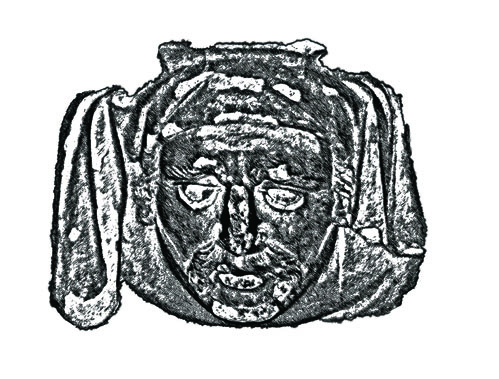
Carvings of green men continued to flourish throughout the middle ages, especially in churches. Several 14th century examples can be seen on the scalloped stone canopy which adorns the tomb of Bishop Hamo of Hythe located near the Pilgrim Steps in the North Quire Aisle of Rochester Cathedral.

This popular motif was revived in 1840 when several brightly painted Green Men roof bosses were added to the Crossing ceiling. This was probably influenced by architect Lewis Cottingham who was in charge of Cathedral renovations from 1825 – 1840. Medieval themes were popular with the Victorians, influencing not only contemporary visual arts but also literature.

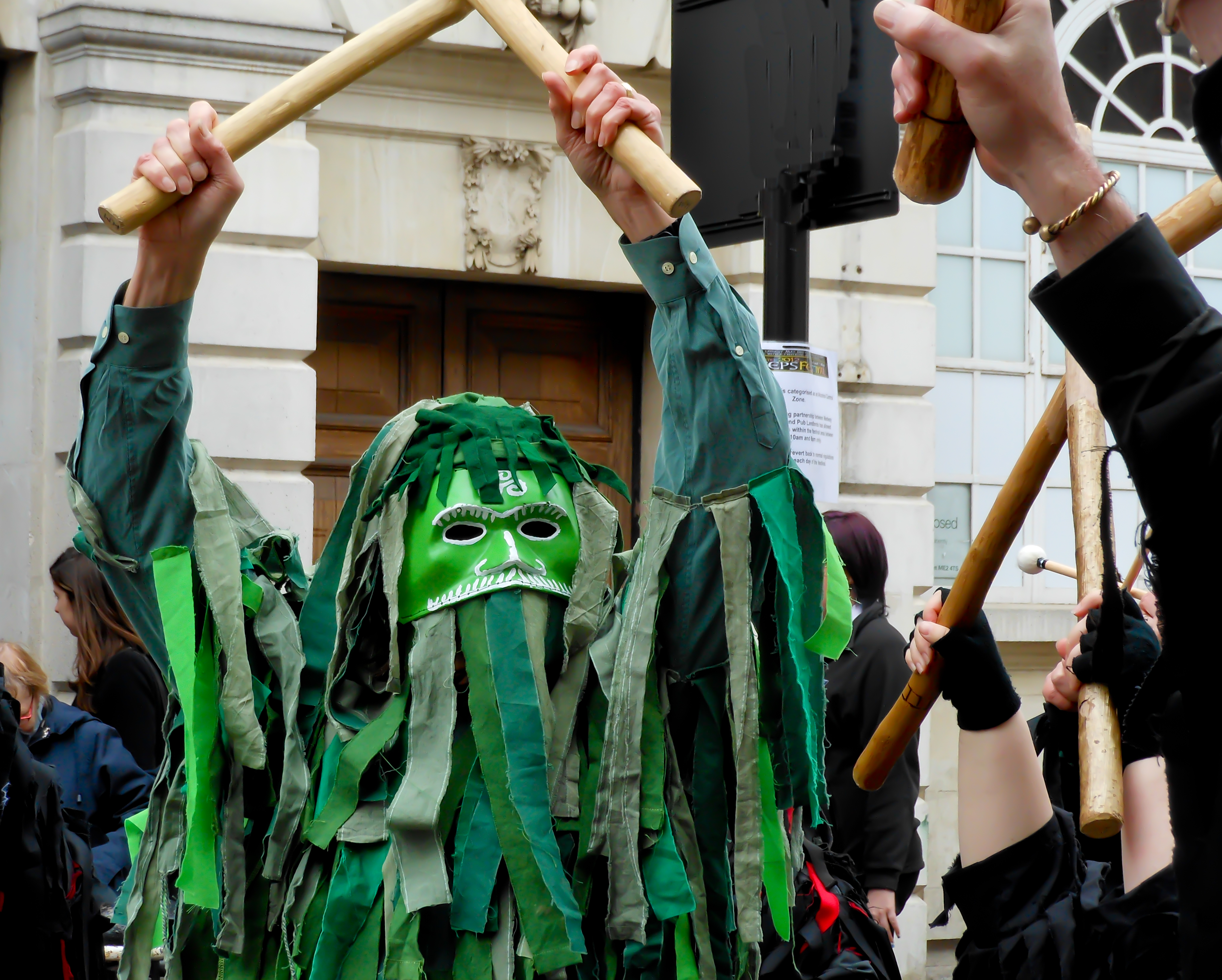
GM-DSCN1821Another character which is closely related to the Green Man carvings is the character of ‘Jack-in-the-Green’ which regularly accompanies Morris dancers during May Day celebrations. Since 1980, Rochester has hosted its own popular version of these celebrations called the Sweeps’ Festival.

Theories as to the origins and meaning of the Green Man are as numerous as those relating to UFO’s and alien life-forms. Perhaps it is its mystery that has turned this motif into such a popular metaphor for so many cultures. In fact, it is the central theme for a story entitled ‘Jack’; one of a selection of short stories inspired by Rochester Cathedral and its treasures which appear in my new book Barley Bread and Cheese.

When I gave a public reading of ‘Jack’, one of the audience told me that he knew a storyteller who had set himself the task of counting all the stories relating to green men. So far, he said, some 83 had been recorded. That must mean that my story is number 84.

So, in 20th century astronomical parlance, would that be LGM-84?

Additional links and information:

Click here for Barley Bread and Cheese

Click here for T. Thurai’s website

Click here for Rochester Cathedral, UK

Click here for Pulsars

Click here for Victorian medievalism (An article by Megan Morris, Rochester University, USA)

Click here for Rochester Sweeps’ Festival

Posted in Uncategorized | 6 Comments