Self-Publishing: what I learned from the gurus

Some hints from the gurus

Some hints from the gurus

Self-publishing has come of age. According to one respected academic, it is now just another arm of the publishing industry.

This is one of the inspiring messages that I brought away from the recent Matador self-publishing conference.

In this third blog on the subject, I thought it would be of interest to list some of the comments and tips from two experts whose lectures I attended.

Professor Alison Baverstock of Kingston University, the academic referred to above, has a background in the traditional publishing industry and has taught and written about the subject for many years. Her research reveals some fascinating facts which challenge many of the old preconceptions about self-publishing.

One such is that self-publishing is for sub-standard, uneducated writers.

However, Professor Baverstock’s research debunks this supposition. She revealed that 32% of self-publishers interviewed by her had a degree while 44% had a higher degree. (See her blog for the Guardian for more on this subject)

The results of her survey also show that 65% of self-publishers are female.

While this is encouraging, I suspect that the high preponderance of female self-publishers may also highlight a darker side to the publishing industry: that is, a distinct gender-bias. This continuing inequality in the traditional literary and publishing industry is the topic of frequent research by the American-based organisation, VIDA: Women in Literary Arts

My suspicion is, that finding themselves largely excluded from a traditional publishing industry which seems to focus heavily on crime-writing and romantic fiction (traditional genres for female writers), many women with original ideas are turning to self-publishing.

The advantage of this is that female authors such as Kit Berry have begun to invent their own genres. Once successful, they have a route into traditional publishing houses and, because of their strong commercial position, are more likely to be able to dictate the terms of their contracts.

Helen Lewis, Director, Literally PR discussed the secrets of running a successful book launch. This is a tiger-trap for many debut authors (including me!) who are so keen to get their first book published that they forget to plan any form of advance PR. It’s simple, really. If you don’t tell anyone your book is out there, how will they find it?

Firstly, consider whether you really need a book launch. Launches cost money and this could be spent more usefully on a publicity campaign

Calculate the total cost. Factor in items such as: the cost of a venue, building your guest list, food and drink, goody bags, décor and entertainment.

If you decide on a book launch, set a date and allow at least 5 months to organise it. Work on your mailing lists and social media to create a buzz. Give journalist invitees 3 – 6 months advance notice of the launch.

Consider filming your launch (and the preparations for it) and posting clips on YouTube.

And for all those authors (most of us, I think) who get hung up about the subject of bookshop signings, here’s a pearl of wisdom. Don’t bother. Bookshops are not expert at creating publicity and the press are unlikely to attend.

Phew! That’s one less thing to worry about.

Click here for my website 


Posted in Books, conferences, publishing, self-publishing, women self-publishers, women writers, writing, Writing Advice, Writing Tips | Tagged , , , | Leave a comment

Self-Publishing: 7 ways to get the most from a conference

Write up conference notes asap!

Write up conference notes asap!

Having recently attended Matador’s conference on self-publishing, I thought it would be useful to jot down a list of essentials to help you to get the most from a conference whatever the topic.

Prep your questions in advance. Why are you going? What do you want to learn? Which lectures would help you most? Try to identify the gaps in your knowledge.

Take lots of writing materials. You always need more. Write up notes asap. It will be fresh in your mind so you should still be able to decipher illegible text.

Remember your business cards. You will get through a stack of these at an event. If you haven’t got them, then get some quick. You will regret it if you don’t. Always remember to get other people’s cards. They can provide a valuable follow-up.

Make friends. You can learn a lot from speaking to other people. At the self-publishing conference, I met a couple who had started their own self-publishing business, a lady who was ghost-writing the story of a disabled celebrity and a fisherman who was planning to crowd-fund his book. Most pertinent to my interests was a former Reuter’s correspondent who had worked in Ceylon in 1956, the year that provided a turbulent setting for my historical novel The Devil Dancers.

Share concepts without giving away unique information. A lady behind me in the lunch queue was describing the intricacies of her novel’s plot to a complete stranger (and anyone else within earshot). A very bad idea. Most people are honest but, as a young and inexperienced freelance journalist, I had a raft of ideas stolen by a national magazine. It was extremely galling to see my story ideas being written by staff writers without a penny paid to me. There is no copyright in ideas so your only recourse is to rant to thin air.

Keep an open mind. Even if you think you know a subject inside out, there is always something new to learn. Try to let go of prejudices. Things are done very differently in this media-savvy age. While it may be galling for a vlogger who can hardly string a sentence together to be offered a book deal, it’s because he/she has a large following. Don’t get sniffy. Get down with the kids and follow their example. Traditional publishers are no longer able to give long-term nurturing to the next generation of great writers. They can’t afford to. Margins are too tight. What counts now is the bottom line. If you can show commercial nous – and a healthy media following – you have a better chance of both getting your work accepted and selling it once it is published.

Ask for advice. Don’t be shy. No question is silly. You’re here to learn. Speak up and you will find that there are lots of other people wrestling with similar problems.

Next: Self-publishing: What I learned from the gurus

Click here for my website


Posted in book festivals, Books, Ceylon, conferences, Copyright, Fiction, History, publishing, self-publishing, The Devil Dancers, writing, Writing Advice, Writing Tips | Tagged , , , , , , | Leave a comment

Self-publishing? Take a tip from Leicester

Be a self-publishing warrior!

Be a self-publishing warrior!

On the same day that Leicester celebrated its Premier League win, the city also hosted Matador’s annual self-publishing conference.

A tenuous connection? Perhaps. But there are similarities between the trials of the football team and the tribulations of the self-publisher.

Both stories have a David-and-Goliath quality. A few years ago, success in either case both would have been unthinkable.

Just six years ago, when I attended the London Book Fair, self-publishing was still synonymous with ‘vanity’ publishing. The disdain shown by agents, booksellers and traditional publishers was tangible.

The fact that Matador’s annual conference is only in its 4th year is testament both to the growing importance of self-publishing and the willingness of the industry to take it seriously.

Self-publishers are now giving the industry a serious run for its money, challenging preconceptions and business models. Unlike their counterparts in the behemoths of the publishing industry, they are all-rounders; IT literate, technically-skilled and both business and media savvy.

So what does a self-publishing conference offer?

  • It can provide novices with a clear plan of action. The problem today is not that there is too little information on this subject, but too much. It can be daunting for the beginner.
  • It can help those with more experience to identify gaps in their skills and keep them up to date with changes in the market. For example, choosing the right book-cover is a tricky exercise. A few years ago, a glossy cover was acceptable. Today, it is not.
  • Writers also benefit from attending self-publishing conferences. They will get an idea of what services are available, who can provide them and how much they can do themselves within a restricted budget. Crucially, they will also get advice on PR – either doing it all themselves or buying in help from an expert.

While writers tend to be a retiring by nature, there has never been a greater need for them to promote their own work. This is true, not just of self-published authors, but also of those who are traditionally-published. Unless you are one of the big names (e.g. a celebrity or blogger with a huge following), it is unlikely that publishers will provide any money for your marketing – if at all.

This was borne out a few years ago when I attended a joint book promotion with a number of other authors. One was a debut author with a traditional publisher who had not been instructed to arrange her own publicity or organise her campaign in advance. She sat forlornly at her stall without completing a single signing while her desperate parents canvassed us for advice. What should she do?

I did not have the heart to tell them that it was too late, that her book would probably be remaindered within a matter of weeks because, without pre-publicity, it could never achieve the sales required by a traditional bookseller during its limited shelf-life (about 12 weeks).

These days, no writer is an island. Whether famous or not, they must all take an active part in publicity and the planning of their pre-launch campaign.

In this respect, self-published authors have an advantage over those who are traditionally-published. They are free to continue promoting their books and selling them through whichever media best suits them. Slow-burning, long-tail sales may be frustrating but they eventually bring rewards and extend the life of a book.

As a self-published author, you have more control over your work. If you are traditionally-published and the book does not sell, you are spared tedious negotiations with the publisher to re-acquire the rights to your material.

And what will you do with your manuscript once it has been reclaimed?

Why, self-publish, of course!

Next: 7 ways to get the most from a conference

To find out more about my books and interests, click here for my website

Posted in Books, publishing, self-publishing, writing, Writing Advice, Writing Tips | Tagged , , , , , , , | 2 Comments

A Canterbury Tale: sudden death and a hint of poison

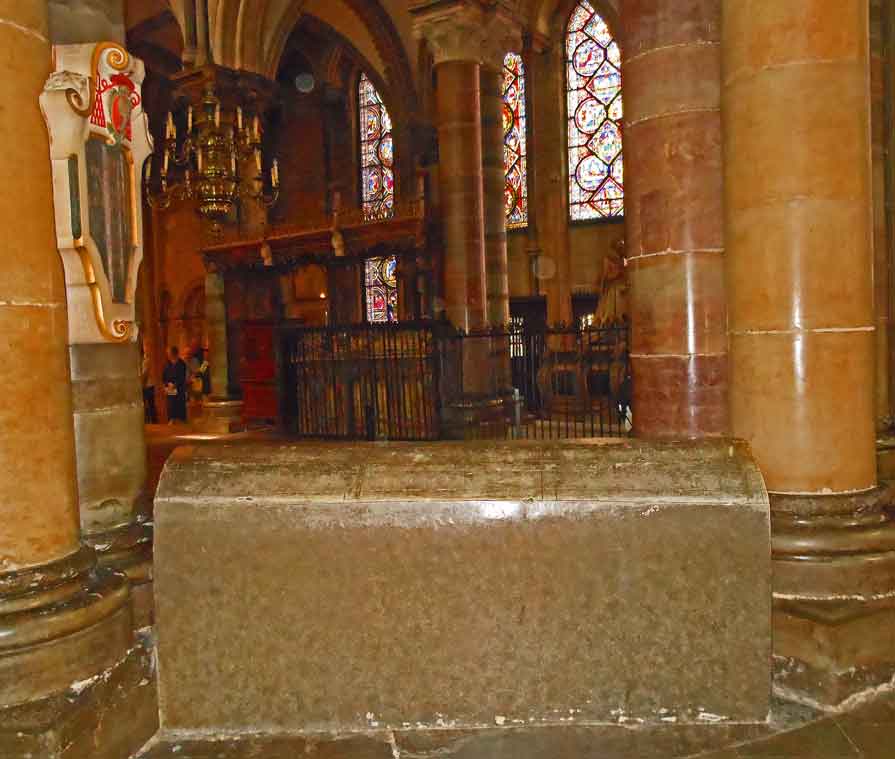
At the east end of Canterbury Cathedral is a mysterious tomb. Placed awkwardly between two pillars, it lies in one of the Cathedral’s most prestigious burial sites, the Trinity Chapel, formerly the location of Becket’s shrine. This unadorned tomb is so plain that visitors pass by unaware of its fascinating history: one that involves murder, betrayal and attempted grave robbery. Who is the occupant of that humble tomb resting near to the Black Prince?

DSCN8838-Odet-for-web-and-blog

The Huguenot Cardinal

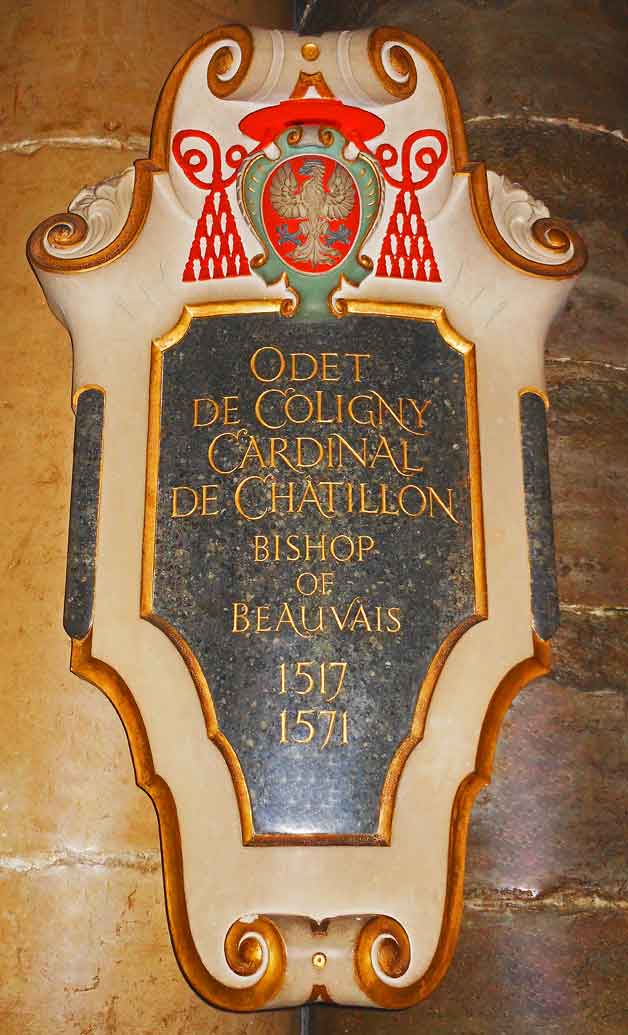
Attached to one of the pillars above the tomb, a scrolled memorial tablet declares: ODET DE COLIGNY CARDINAL DE CHATILLON Bishop of Beauvais 1517 – 1571.

Odet was born into one of the most influential families in France. Brought up at the Renaissance court of King Francis I, Odet’s early life was one of privilege. Although never ordained, he became a Cardinal at 16, attended papal elections in Rome and added the wealthy Bishopric of Beauvais to his clutch of spiritual titles.

Yet despite this cynical acquisition of power – largely engineered by his uncle, the Constable of France – Odet was a man of conscience. When his friend Rabelais was accused of heresy, Odet protected him. To express his gratitude, Rabelais dedicated a book to “The most illustrious prince and most revered Odet Cardinal of Chastillon”.

Odet’s conscience also inspired him to champion the Huguenot reformers and become a Protestant. Despite being excommunicated by the Pope – and having married – Odet was initially protected by the French court, remaining close to the Dauphin and the Queen Mother Catherine de Medici. However, Catherine subsequently turned against Odet and his powerful brothers, issuing an order for their arrest. While his brother Gaspard, the Admiral of France, fled with his followers to La Rochelle, Odet sought refuge in England.

When he landed at Dover “somewhat sickly of sea”, his arrival with some 30 retainers caused consternation. The Governor of Dover, not knowing what to do, wrote a frantic message to Lord Cecil, the Queen’s chief adviser, marked “haste, haste, haste … for the Queen’s Majesty’s Affairs.”

In an attempt to find temporary lodgings for Odet, Cecil wrote to Edmund Grindal, Bishop of London. However, Grindal proved reluctant, possibly due to the size of Odet’s retinue. Replying to Cecil’s enquiry, he wrote: “I pray you to spare me, for surely I lack convenient furniture”.

Further problems arose when Thomas Sackville was ordered to house Odet and his followers at the Palace of Sheen. Unable to provide sufficient furniture, plate and linen for the needs of Odet and his companions and stung by the criticisms of the Queen’s agents, Sackville retorted that not only had he had to give up his own basin and ewer but that his wife’s waiting women had had to give up their bed and sleep on the floor!

Hoping to move to London, Odet was to experience problems similar to those experienced by many modern flat-hunters. He refused one house because “he found the walls and windows in so great decay that it would be hard for my lord Cardinal to repair it in so short a time.”

Although England provided a refuge from immediate danger, Odet’s movements were closely watched by both the French and Spanish ambassadors. Having invited Odet to stay with him, Sir Thomas Gresham noted that “the Cardinal had not been a quarter of an hour in my house, but the French ambassador came to visit him” and that the two had “long communications”.

When Odet visited the French Huguenot church in Threadneedle Street, he abandoned his Cardinal’s robes for “a short cloak with a rapier” and – as the Spanish ambassador noted – a jewel in his cap.

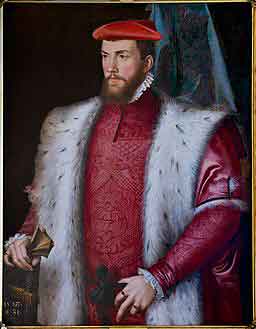
A dashing figure, Odet was described by one observer as “a handsome old man with a good figure, a long white beard, dressed always in black with a great ‘saye’ of velvet or satin and a long cloak.”

A man of great personal charm, he won the favour of Queen Elizabeth causing her favourite, the Earl of Leicester, to note: “Her Majesty had a marvellous liking of him: and one thing more than I looked for, which is, her liking to hear of his wife, and is very desirous to see her, and hath sent one expressly to visit her.”

Odet-image-for-web-&-blog

Leicester’s surprise at this gesture was due to the fact that Elizabeth disapproved of clergy wives.

While in England, Odet tried to enlist the Queen’s help for his co-religionists – especially those at La Rochelle. Disguised as Odet’s retainers, Huguenots obtained access to Elizabeth’s court and were given loans from her Treasury. However, they never received the military help in terms of men and materiel that they desired. As the leader of a small Protestant nation, Elizabeth was treading a tight-rope between the great Catholic powers of Spain and France. She could not afford to attract their combined hostility.

In 1570, Odet’s brother Gaspard marched on Paris and forced Queen Catherine to agree a treaty. Odet was eager to return home but bad weather and his wife’s illness caused him to postpone his plans.

Finally, he set out for Dover, breaking his journey at Canterbury where he lodged with prebendary John Bungay whose house at ‘the Homors’ was located near the east end of the Cathedral. During this visit, Odet was presented with a gift of “ducks, mallards, teeles, wood-koks and partridges” by the Corporation of Canterbury.

Sadly, Odet never returned home. He fell ill with a fever and, after languishing for several weeks, died on 23 March 1571.

 A murder mystery?

Odet’s brother, Francis, had died two years earlier amid rumours of foul play by Queen Catherine. Although she denied the accusations, Catherine wrote of her “great pleasure” at his demise and her “hope that God will give to the others [i.e. Huguenots] the treatment they deserve…”

When Odet died, his widow claimed that he had been murdered. At the post-mortem, Odet’s physician said that spots on Odet’s stomach indicated poisoning. In a subsequent report, Queen Elizabeth’s Commissioners said: “There appears to be no ground for suspicion that he had been poisoned.” Nonetheless, they failed to reach a final verdict.

Two years later, the stories of poisoning re-surfaced. According to one theory, the murderer was Odet’s valet-de-chambre, a Basque called Vuillin working for Queen Catherine.

Truth or rumour? Who knows.

What is clear is that a year after Odet’s death, Queen Catherine ordered the assassination of his brother Gaspard and the massacre of Huguenots on St Bartholomew’s Day.

Meantime, Odet had been given a temporary tomb in Canterbury Cathedral. (It was not even recorded in The Chapter Burial Register). Quickly bricked over and covered with a layer of plaster, his coffin awaited collection by his family. But, overtaken by war and death, they never came.

DSCN8836-Odet-for-web&-blog-2


A tale of tomb robbers

In August 1990, two ex-Foreign Legionnaires were arrested in the Cathedral precincts. They were equipped with an impressive burglar’s toolkit and a map of the Cathedral. The explanation for their escapade bemused Canterbury magistrates. The two men claimed that they were hoping to open Odet de Coligny’s tomb and prove that it held, not the bones of the Huguenot exile, but those of Thomas Becket whose tomb was dismantled during the Dissolution of 1538.

*For further information on Becket – especially some of the less well-known facts – see my previous article: Murder, Martyrdom and the Quest for Bones.

Posted in Canterbury, Cathedrals, Exiles, History, Huguenots, Odet de Coligny | Tagged , , , , , , | Leave a comment

The Devil’s Advocate? Witches vs The Law

Francisco_de_Goya_y_Lucientes_-_Witches_in_the_Air_-_WGA10028

What images are conjured up by the word ‘witch’? Hags silhouetted against the night-sky performing aerial acrobatics on broomsticks or brewing strange potions in a cauldron? Strange old ladies accompanied by black cats? Or children with black pointed hats and painted faces hammering on your door at Halloween and demanding sweets with menaces?

For most of us, a witch is just a caricature, a figure of fun. However, history – and the law in particular – tell another story. Often poignant and frequently gory, legal records provide an insight into changing social attitudes to magic through the centuries.

What’s in a name?

Definitions are essential in legal documents so it seems appropriate to consider some of the words relating to witches and their pursuits:

Magic – thought to be derived from the Old Persian word “maqush” which means ‘to be able, to have power’. This formed the root of the Ancient Greek word ‘magike’ and the word ‘magos’ which referred to learned men of the priestly class. Remember the Magi or Wise Men in the Bible?

Necromancy – ultimately derived from Greek and referring to divination by communication with the dead. For example, the Biblical example of the Witch of Endor who conjured up the spirit of Samuel in order to answer King Saul’s questions about the outcome of a battle.

Sorcery – in Medieval Latin, the word sortiarius means “a teller of fortunes by lot”. The words for sorcery (sorcerie) and sorcerer (sorcier) first appeared in medieval French c. 1300.

Witch – from Old English ‘wicce’ a female magician or sorceress and ‘wicca’ a wizard who practised magic or witchcraft.

An ancient fear

Treated as a capital offence in Ancient Greece and Rome, necromancy was punishable by burning.

By comparison, the early legal codes of European tribes such as the Franks offered some less stringent forms of punishment including fines.

Dealing with the in-laws (and their loot)

In the Middle Ages, accusations of witchcraft were a useful means of discrediting otherwise guiltless parties and, more importantly, grabbing their assets. Two examples of this can be found in Henry V’s family. His stepmother, Joan of Navarre, had been endowed with a generous sum of 10,000 marks per annum – the largest amount granted to an English queen to date.

Joan_of_Navarre,_queen_of_England-blog

Joan of Navarre, Queen of England

Although Henry V enjoyed cordial relations with his stepmother, Joan had close French ties while Henry, pursuing expensive campaigns in France was casting covetous eyes on her income. The result? Joan was accused of trying to bring about Henry’s death by means of sorcery and witchcraft. She was arrested and her possessions seized. The benefit to Henry in just 14 months amounted to £8,000 (the modern equivalent of £3,754,800). Joan was never brought to trial and lived under a comfortable form of house arrest until she was pardoned a few weeks before Henry’s death. She now rests beside her husband, Henry IV, in Canterbury Cathedral.

Henry V’s sister-in-law, Eleanor of Cobham, was subjected to similar accusations although the outcome was less happy. The daughter of a low-ranking knight, Eleanor had made a love match with Henry’s popular brother, Humphrey duke of Gloucester. The couple amassed great wealth and created a glittering court at Greenwich.

Humphrey stood next in line to the throne if his nephew, Henry VI, died unmarried. In an attempt to assess her chances becoming queen, Eleanor consulted an astrologer. She also bought potions from Margery Jourdemayne, the witch of Eye, to help her conceive a child. Unfortunately, rumours of these activities began to circulate, playing into the hands of Humphrey’s enemies. Their first move was to have Eleanor accused of trying to poison the young king by witchcraft.

She was forced to divorce Humphrey and to do penance by walking barefoot through the streets of London holding a candle and dressed only in her shift. For the next eight years, Eleanor was imprisoned and moved around a succession of castles – all remote from London – until she died, abandoned and forgotten, at Beaumaris.

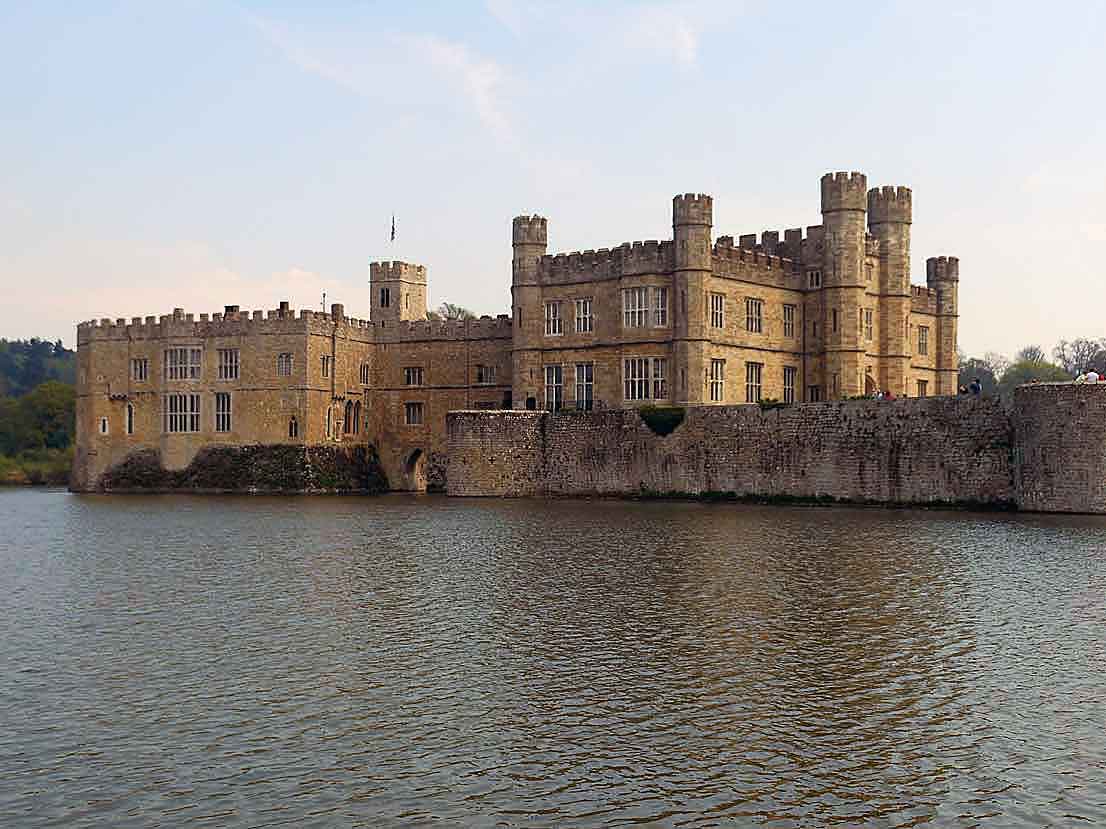
Leeds Castle where Joan and Eleanor were imprisoned

Leeds Castle where Joan and Eleanor were imprisoned

A bumpy ride

When King James VI returned to Scotland with his Danish bride in 1590, the royal fleet experienced such bad weather that it was forced to divert to Norway where it had to sit out the storm for several weeks. Possibly due to embarrassment and frustration, the Danish admiral blamed the bad weather on the wife of an official in Copenhagen. This resulted in a series of witch trials which began in Denmark and continued in Scotland with the encouragement of King James. So began an ugly two-year episode of accusations, torture, trials and executions at North Berwick. Even the Earl of Bothwell – the king’s cousin and something of a thorn in the royal side – was accused of treasonable necromancy.

Fortunately for Bothwell, he managed to force his way into the king’s bedchamber and plead his innocence. He was subsequently pardoned and acquitted at trial. Not so many of the other, humbler accused such as Agnes Sampson, healer and midwife, who was personally questioned by the king and confessed to sorcery under torture. She was garrotted and burned at the stake.

The North Berwick witch trials were the first major prosecutions in Scotland under the Witchcraft Act 1563 which treated both the practice of witchcraft and consulting of witches as capital offences. It seems likely that the North Berwick trials only whetted King James’s obsession with witches. In 1593, he wrote a book called Daemonologie a treatise on magic and witches which not only reveals James’s superstitions but also many of the classical sources on which he based his arguments.

17th century sport

The 17th century witnessed a spate of witch trials across Europe and America, including the infamous persecutions at Salem. However, while witch trials and hangings were still taking place in provincial Devon in 1682, the Capital seems to have lost its appetite for witch-hunting. Accusations of witchcraft against two elderly women – Jane Kent and Jane Dodson – were dismissed at the Old Bailey in 1682 and 1683.

In 1699, the case of Mary Poole indicated the future direction – and downgrading – of witchcraft laws. Poole was a gypsy who appears to have made her living by playing on people’s fears and using sleight of hand to steal their money. The Plaintiff claimed that she “showed him some Juggling Tricks, till she had Juggled away his Money”. Another witness told how she had caused his horse to fall down and had mysteriously appeared at a point in front of him in the road. However, the judge and jury were not taken in by Poole’s prophecies and tricks and found her guilty of grand larceny.

It is thought that the last person to be executed for witchcraft was Janet Horne at Dornoch, Scotland in 1727.

The triumph of Enlightenment

In 1735, a new Witchcraft Act was passed which, contrary to its title, marked a triumph in enlightened thinking and a shift in the law. At a stroke, the old laws based on a belief in the existence of witches became obsolete. Aiming to punish charlatans who conned gullible people out of their money, the new Act foreshadowed modern consumer law.

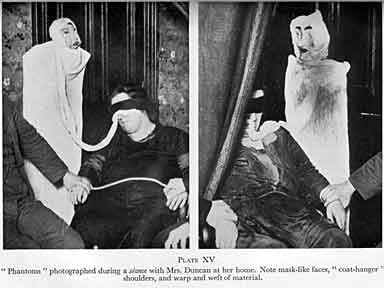
Helen_Duncan_fake_ectoplasm-blogsizeIt was even invoked in 1944 in the case of Helen Duncan, a medium whose ‘ectoplasm’ was revealed to be a long length of cheesecloth and who attracted the attention of the naval authorities in war-time by claiming to have had a message from a sailor drowned on HMS Barham. At the time, it was thought that few people knew of the Barham’s sinking, although subsequently it was shown that the news had circulated quite widely and that Duncan had probably picked up the information by listening to gossip. Fearing that she might betray secrets relating to the D-day landings, the military authorities used the Witchcraft Act to get Duncan jailed for 9 months in 1944.

In 1951 the Witchcraft Act was repealed and replaced by the Fraudulent Mediums Act which, in turn, was superseded in 2008 by new Consumer Protection Regulations based on an EU directive.

As far as the law is concerned, witches no longer exist!

Posted in Canterbury, Cathedrals, History, Law, Myth, Witches | Tagged , , , , , , , , , , , , , , , | 2 Comments

Procrastination? 10 Ways to Spot the Signs

Feeling crushed? Avoid distractions and face the challenge

Feeling crushed? Avoid distractions and face the challenge

I confess. I’ve been avoiding it. Returning to the section of my novel which I put aside a couple of years ago and to which I must return if I am going to finish the book.

Why has this taken so long?

Well, various things got in the way.

These included: publicising my first novel The Devil Dancers (after nine years of research and writing, I couldn’t just launch it and walk away); writing a book of short stories and publicising that (admittedly, I didn’t have to write that one, but it just happened); illness; the loss of a close family member and all that that entails.

Distractions have come thick and fast, each demanding attention and, in all honesty, I could not have avoided any of them.

Fortunately, it didn’t stop me writing. I didn’t abandon the second novel altogether, but took the wise advice of another writer who said that when life gets tricky, try to write sections rather than one, long continuous narrative.

Brilliant! It really worked. I concentrated on specific characters and wrote scenes from their lives which I could slot into the novel and I’ve got a lot of material.

But there’s still that section that I wrote several years ago, the core of the novel which I now know I am going to have to re-write. It’s going to involve a lot of work and, oh dear, I really don’t want to tackle it.

The trouble is, I’ve discovered that I have a great talent for procrastination. Here are the symptoms:

1) The sun is shining, I need to: go for a walk/do the washing/weed the garden

2) My husband/ cat/mother needs me. If I don’t pay them attention, I will be failing as a wife, pet-owner, daughter

3) I need to phone a long-lost friend (guaranteed to last 1 hour)

4) The oven needs cleaning

5) There’s a funny smell under the sink

6) I need to check the post. Better check the freebie newspapers, brochures, leaflets etc. before I chuck anything away – just in case!

7) Disaster! I’ve run out of milk/cat-food/chocolate. A trip to the shops is urgently required

8) I’m sitting at my desk but: my chair is uncomfortable – I need to change it/find a cushion; I need a glass of water or, even better, coffee and a biscuit

9) I’ve switched the computer on but first: I’m going to read my emails (there are two that need replies right now); catch up on social media (must maintain my author profile!)

10) Goodness, it’s lunch-time! I really can’t work on an empty stomach

I’m delighted to say that, after compiling my list of weaknesses, I finally tackled the piece of work that I had been dreading for so long.

It seems that the cure for procrastination is to teach yourself to spot the signs and, however much they tug at your conscience, learn to ignore them. It takes as much discipline not to do certain things as it does to tackle others. It’s just a matter of setting your goal and sticking to it – however bad the smell under the sink.

And, if anyone spots me slipping from the straight and narrow, please, just remind me to read this!

Posted in Writing Advice, Writing Tips | Tagged , , , , , | 3 Comments

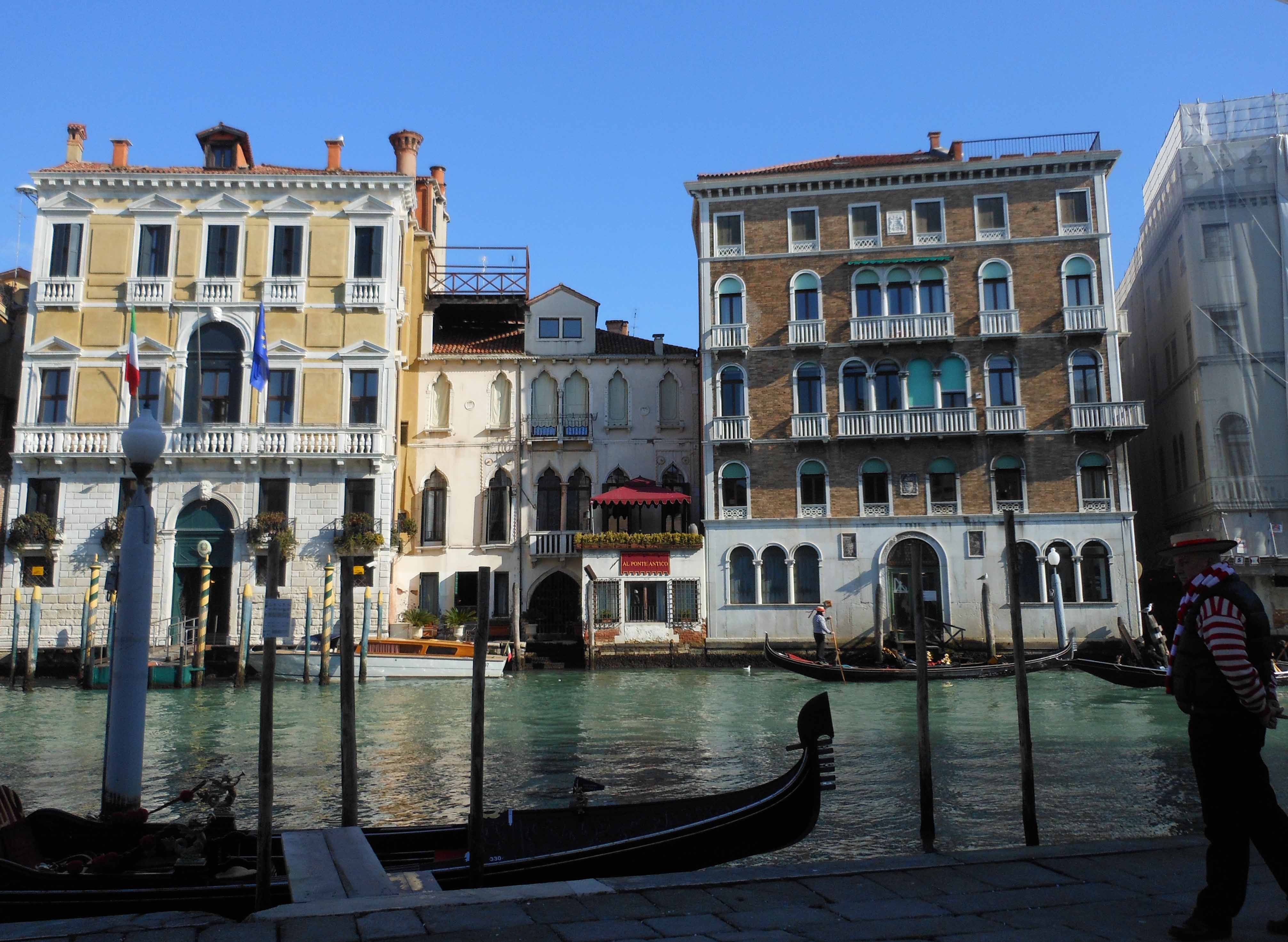
Venice’s Palazzi: Jewels of the Grand Canal

Beyond the Bridge of Sighs! The Ponte della Paglia is often crowded

At Carnival and in summer, Venice is submerged. But not by the green waters of the lagoon. St Mark’s Square, the Rialto and the main shopping streets are flooded by a relentless human tide. Tourists pose for interminable photographs on historic bridges and the narrow streets, known as calli, resound with the incessant rattle and bump of wheeled cases.

One glimpse of the heaving mass on the Ponte della Paglia is enough to deter the faint-hearted. Yet beyond the mayhem lie quiet oases and historic sites that offer a more tranquil view of Venice’s unique heritage.

Strung along the Grand Canal like pearls on a necklace are the palazzi: grand houses, hundreds of years old, some dating back to the middle ages. Originally built as private dwellings for Venice’s wealthiest citizens, a number of the palazzi are now open to the public having been converted into museums and galleries.

Here are two that should not be missed:

Ca’ D’Oro

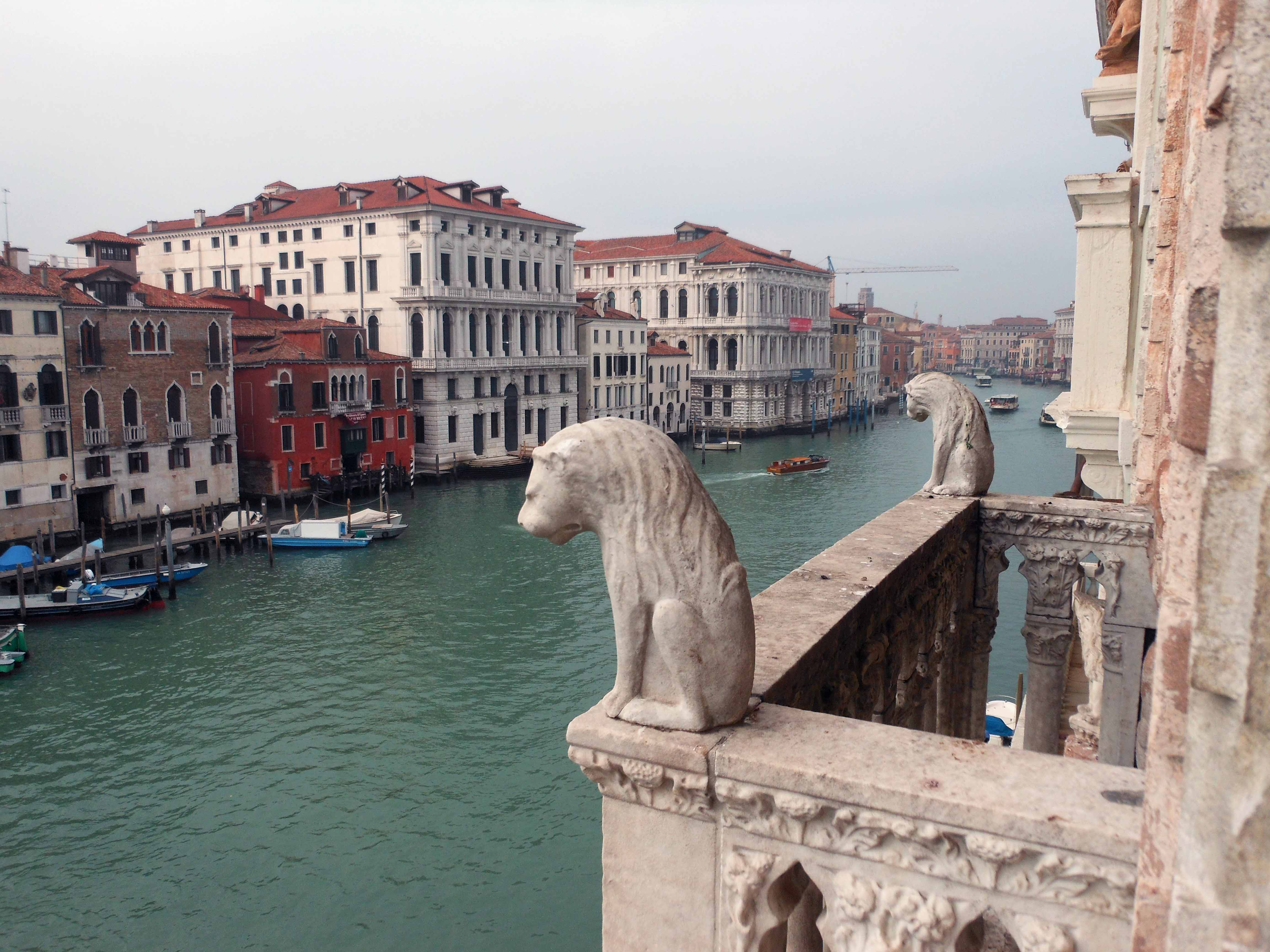
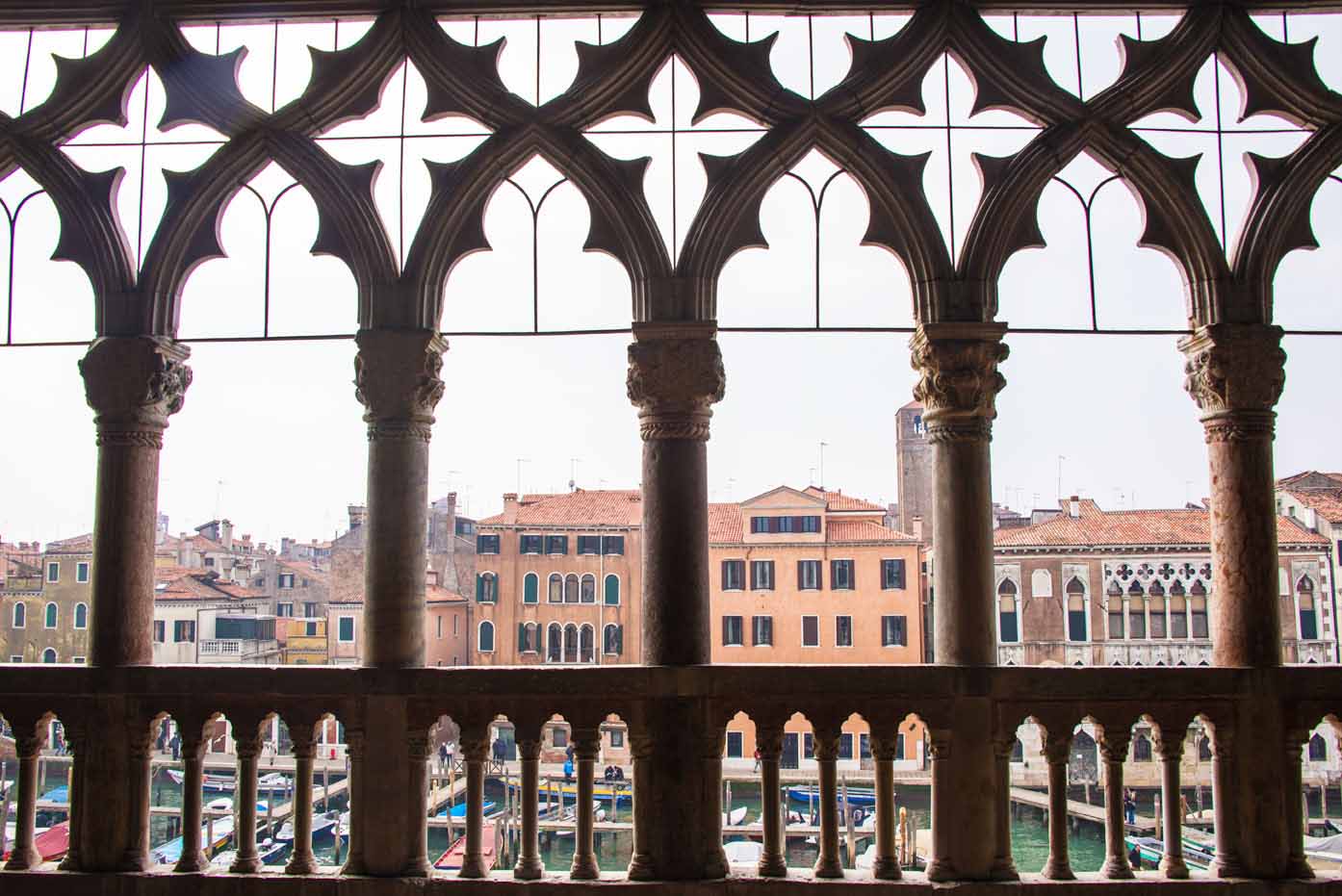
View of the Grand Canal from the Ca' D'Oro

View of the Grand Canal from the Ca’ D’Oro

A real gem, the Ca’ D’Oro, or Golden House, dates from the 15th century and derives its name from the gilding that once adorned the façade.

Built for the merchant Marino Contarini, the Ca’ D’Oro was created by a number of outstanding craftsmen whose names have been preserved for posterity in Contarini’s book of accounts.

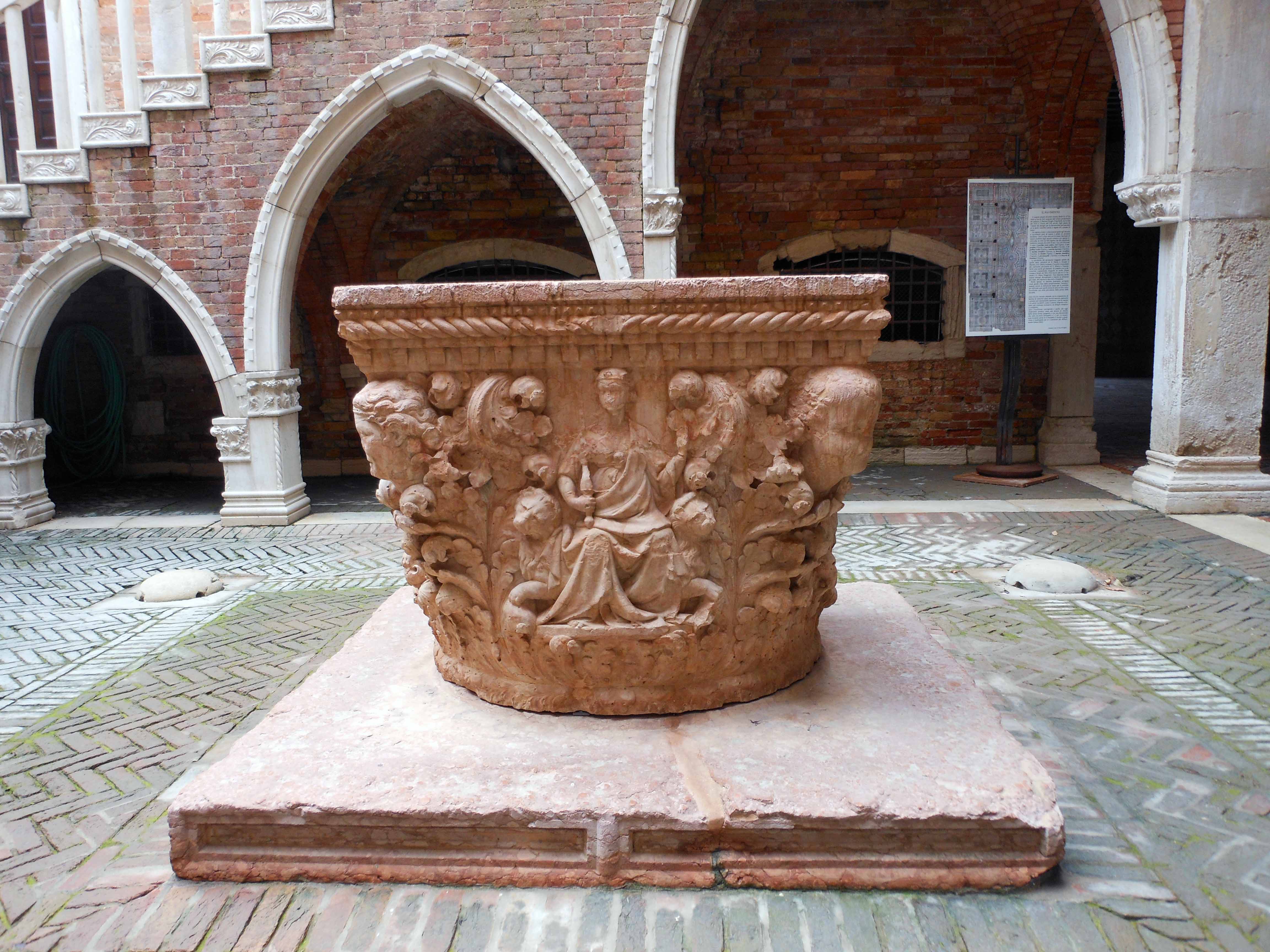
While stone well-heads are a feature of Venice, the one in the Ca’ D’Oro’s tiny courtyard is special; not only because it was carved by leading sculptor Bartolommeo Bon but also because of its location.

The Ca' D'Oro's private well

The Ca’ D’Oro’s private well

Unlike the majority of Venetians, the owners of the Ca’ D’Oro did not have to rely on water drawn from public wells located in the campi or squares. They had their own private supply of fresh water; a priceless commodity in a city surrounded by brine.

A view from the first-floor loggia

A view from the first-floor loggia

Other outstanding architectural features of this building are the loggias; roofed open galleries on three floors which face onto the Grand Canal. Each has a delicate screen of carved stone which would allow the occupants a degree of privacy while allowing them to take the air and view the activity on the Grand Canal.

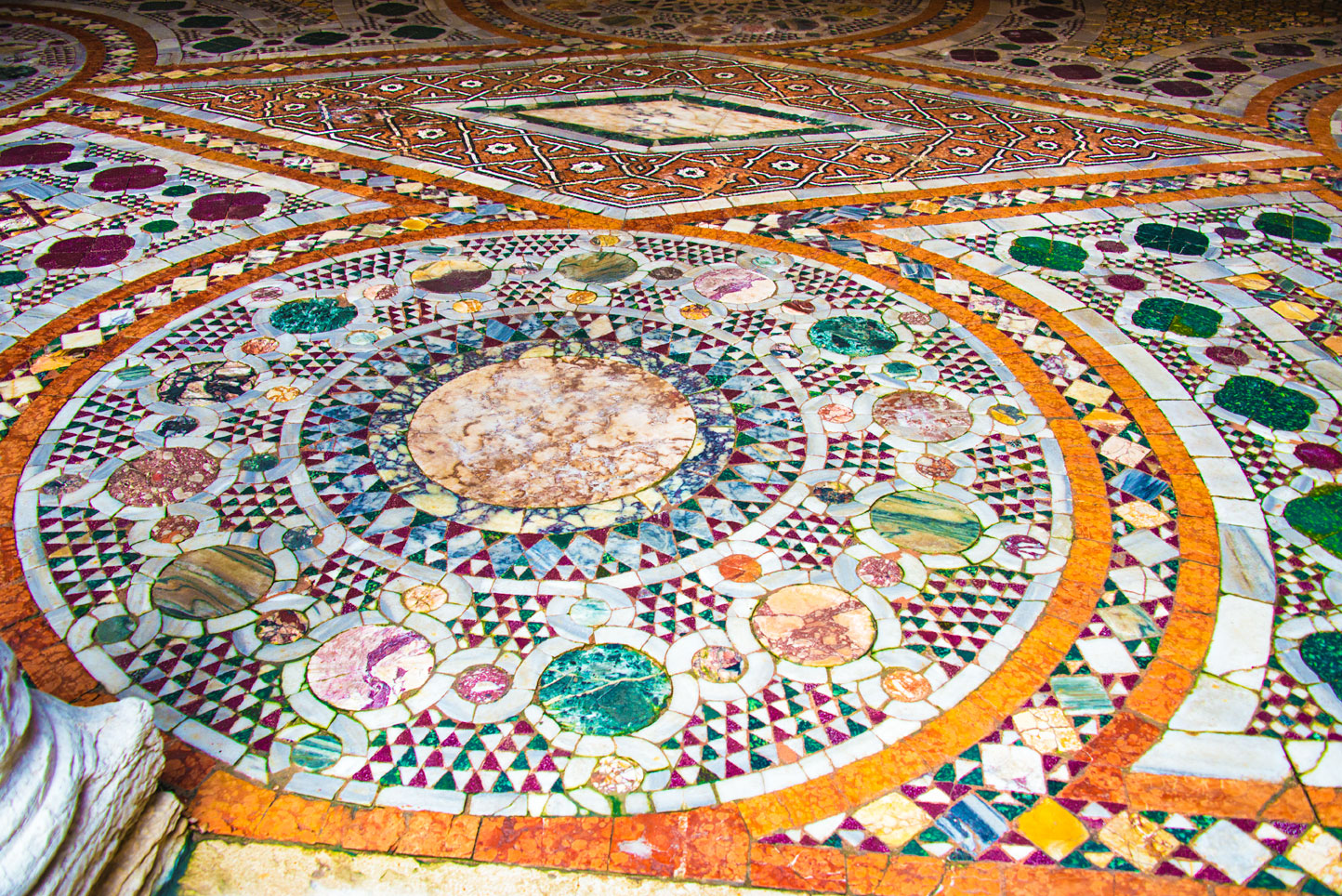
In the 19th century, the ground-floor loggia received a spectacular make-over from the Ca’ D’Oro’s owner, Baron Giorgio Franchetti.

Detail of the spectacular marble floor

Detail of the spectacular marble floor

The floors were paved with elaborate mosaics, resembling those of medieval churches and the walls were covered with a two-tone design of white and red marble. Classical statues have been carefully placed around this space to lighten its shady aspect, creating a retreat conducive to thought and meditation.

From this loggia, a door opens onto a landing stage with direct access to the Grand Canal. You can imagine what it must have been like to arrive by gondola at night and enter this sumptuous grotto lit by candlelight. In summer, it would also have provided a cool refuge from the crowded alleyways and stifling heat of the City.

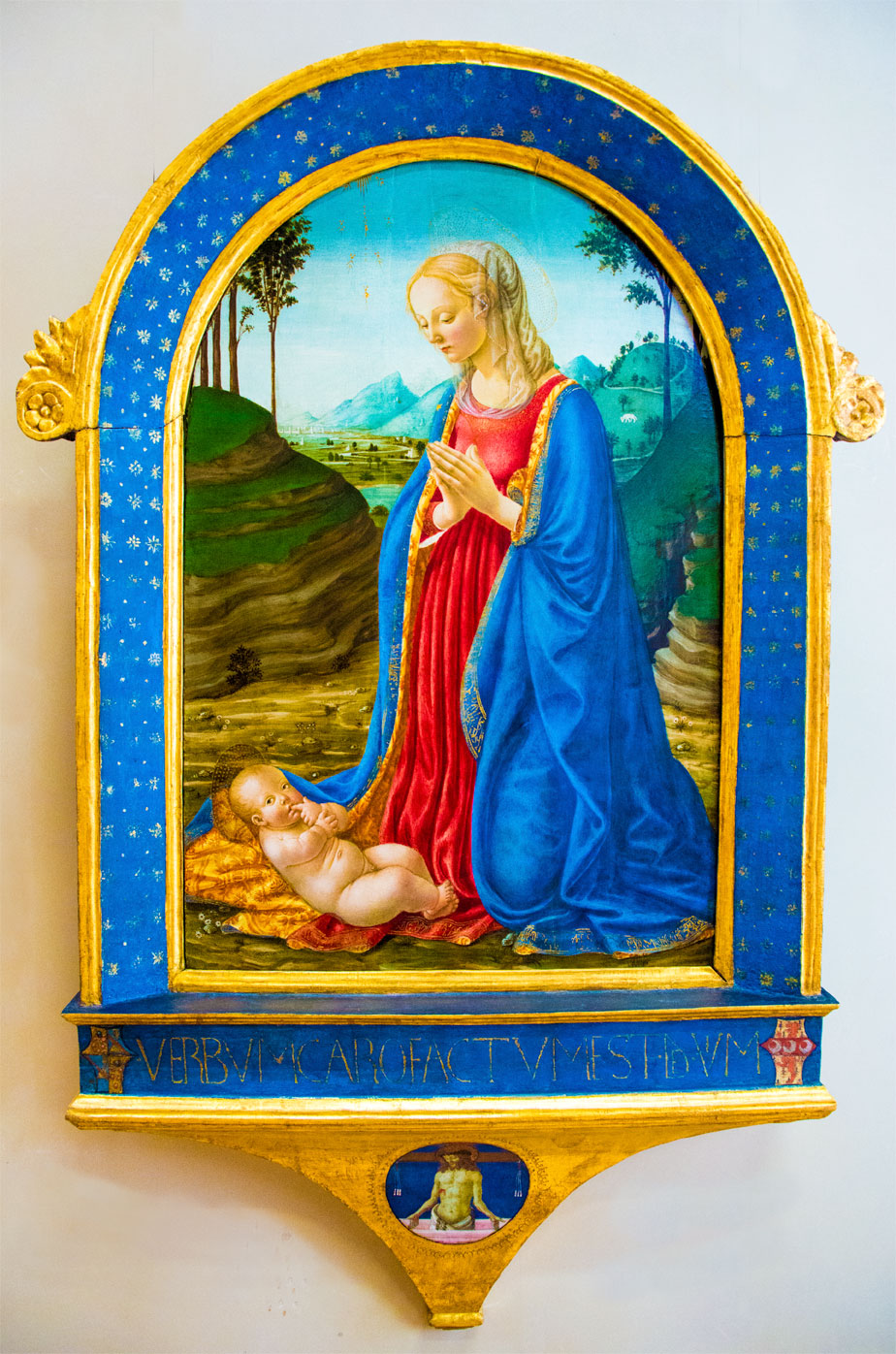
Today, the Ca’D’Oro houses exquisite works of art which include a painting of St Sebastian by Mantegna and numerous bronzes and sculptures.

This collection, together with the house, was donated to the Italian State in 1916 by Baron Franchetti whose remains lie in the atrium.

A painting of the Madonna and child from Ca' D'Oro's collection
A painting of the Madonna and child from Ca’ D’Oro’s collection

 How to get there: Vaporetto, Linea 1, Ca’ D’Oro stop.

Accessibility: The entrance to the Ca’ D’Oro is just a few yards along the passage leading from the vaporetto stop. There is a lift inside to the upper floors. The public toilet is located at the top of a staircase. There are also some steps to the loggias and the bookshop.

Ticket price: Full ticket price 6 euros (more if this includes entrance to special exhibitions). Free entrance for European disabled people attended by a family member or care-worker. Check the Ca’ D’Oro website for reduced price tickets and concessions

Ca’ Rezzonico

A breath-taking example of an 18th century baroque palace, the Ca’ Rezzonico was designed by leading architect Baldassare Longhena who was also responsible for two other celebrated buildings on the Grand Canal: the palazzo Ca’ Pesaro and the famous plague church, Santa Maria della Salute.

One of the beautiful ceiling paintings at Ca' Rezzonico

One of the beautiful ceiling paintings at Ca’ Rezzonico

From a British point of view, one of the most interesting residents was the poet Robert Browning whose son ‘Pen’ bought the palazzo for his father. Unfortunately, Browning did not have long to enjoy it, dying from bronchitis in the year after he took up residence.

Within the inner courtyard is a stunning example of a historic Venetian gondola complete with a shuttered cabin for passengers and exquisitely carved panels.

From ground level, a magnificent staircase leads to the first floor – note the charming sculptures of cherubs representing winter and summer on the bannisters.

A cherub dressed as Winter greets guests on the main staircase

A cherub dressed as Winter greets guests on the main staircase

The size and magnificence of the ballroom/reception on the first floor is jaw-dropping – worth every euro of the ticket price on its own.

It is impossible to describe every detail of this extraordinary building because there is so much to see; sumptuous furnishings, beautiful paintings, works of art at every turn. Highlights include:

Exquisite wood carvings in ebony and boxwood by Andrea Brustolon. While many are described as vase stands and furnishings, they are works of art in their own right. There are over 40 examples of his work in this museum;

Works by Tiepolo include painted ceilings and a series of frescoes transferred from his home at Villa Zianigo. See the accompanying video which shows how modern craftsmen performed this extraordinary feat of removal;

One of the exquisite carved ebony figures from the ballroom

One of the exquisite carved ebony figures from the ballroom

Paintings by Pietro Longhi which show intimate scenes from 18th century Venetian life such as The Fortune-Teller, The Seller of Essences and The Hairdresser. The collection also includes the charming Rhinoceros;

Paintings by Canaletto including View of the Canal from San Vio Square;

Magnificent Murano chandeliers decorated with coloured glass flowers;

Collections of antique china.

The third floor is devoted to the Egidio Martini art collection and three rooms displaying the interior of the Ai Do San Marco pharmacy complete with chemist’s jars. If, by this time, you are too saturated to absorb any more art, it is worth visiting this floor just for the view of La Volta, the bend in the Grand Canal.

How to get there: Vaporetto, Linea 1, Ca’ Rezzonico stop.

N.B. The Ca’ Rezzonico is not well sign-posted from the vaporetto stop. Hopefully, the following directions will help:

At the end of the passage leading from the vaporetto stop, turn right past the front of San Barnaba church. Cross a small bridge and, at the bottom, turn immediately right along Fondamenta Rezzonico, a path which follows a small canal back towards the Grand Canal. The entrance to the Ca’Rezzonico is at the bottom of this path.

Accessibility: The bridge from Campo San Barnaba to the Fondamenta Rezzonico has shallow steps on either side. The ground floor facilities of the Ca’ Rezzonico are well laid out consisting of toilets, a cloakroom, ticket office and bookshop on one side and a café on the other. There is also a lift. The view of the Grand Canal from the third floor window is from a platform accessible by a few steps.

For those unable to get to the Ca’ Rezzonico, the excellent website offers a virtual tour and a video.

Ticket price: Full price 10 Euros. Free entrance for disabled people with helper. Check the Ca’ Rezzonico website for reduced price tickets and concessions

More to explore

Other palazzi which are open to the public include: Ca’ Pesaro (modern and oriental art); Palazzo Mocenigo (Museum of Textiles and Costume) and the Fontego dei Turchi (Natural History Museum. For information on these and other museums, click here

Even the remarkably modern-looking Guggenheim gallery consists of the ground-floor of an unfinished 18th century palazzo

If you read Italian, the Polo Museale Venezia website is a useful source of additional information.

Travelling by water is a good way to see the Grand Canal's pallazzi - and save your feet!

Travelling by water is a good way to see the Grand Canal’s pallazzi – and save your feet!

The best way to view palazzi on the Grand Canal is to take a trip on the Linea 1 vaporetto. This travels reasonably slowly and, if you are in the right position (especially at the back of the boat) will allow you to take some spectacular photographs.

Posted in History, Italy, Travel, Venice | Tagged , , , , , , , , , , , , | Leave a comment

Murder, Martyrdom and the Quest for Bones

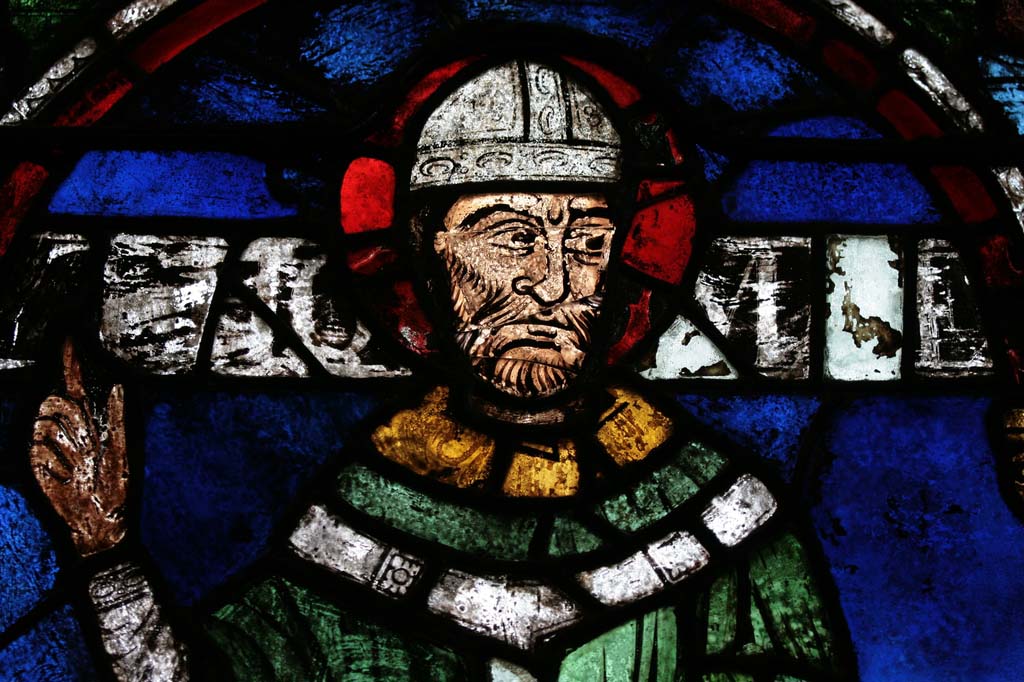
Stained glass portrait of St Thomas Becket from Canterbury Cathedral. Wikimedia Commons CC-BY-SA-3.0.

Stained glass portrait of St Thomas Becket from Canterbury Cathedral. Wikimedia Commons CC-BY-SA-3.0.

As the sun was setting late in December, four armed men strode through the Cathedral precincts determined to arrest one of the country’s most powerful men – or, at least, teach him a lesson. They had probably been drinking and the sound of their voices and heavy footsteps echoed around the silent cloisters. They tried the latch of a heavy wooden door, discovering, to their surprise that it had not been barred.

Pushing the door open, they blinked, their eyes adjusting to the gloom. Candles dripped pools of light onto the stone floor and tall shadows danced among the vaults and pillars. The vast interior echoed with the voices of monks who had been celebrating Vespers, their breath hanging on the icy air like smoke.

A solitary figure was standing by a pillar. He had met the four men earlier in the day, refusing to break off his conversation with another visitor or rise to greet the intruders. After a heated exchange, the men had been forced to leave by the man’s attendants. Thwarted, they had plotted to return later and resolve the matter.

Meanwhile, the object of their hostility had been ushered into the Cathedral for his own protection, his followers believing that he would be safe there.

But now he was alone and unprotected.

Once more, the men tried to take him prisoner, one trying to lift him from the ground and sling him over the back of another accomplice. The captive resisted, fighting back. An arm was raised. A blow was struck. Then another. The man fell to the ground, his skull slashed open, his brains spilling onto the icy stone floor.

On 29 December 1170, Thomas Becket, Archbishop of Canterbury, former Chancellor of England and erstwhile friend of the king, lay dead on the floor of the Cathedral. It was the end of a tumultuous career and the beginning of a legend.

Becket’s murder is so notorious that most of us assume that we know every detail. However, a closer examination of Becket’s life – and legacy – reveals some intriguing facts.

  • Becket was born in Cheapside, London, to Norman parents. His first language was French but his command of Latin – the language of bureaucracy, law and religion – was imperfect.
  • He loved hunting and hawking.
  • He initially earned his living keeping the accounts of a rich relation.
  • He became a favourite of King Henry II who appointed him Chancellor.
  • Becket participated in Henry’s military campaigns in France, taking an active part in the fighting and, on one occasion, commanding 700 knights.
  • Henry appointed Becket to the Archbishopric of Canterbury – an unpopular decision with both the English bishops and the monks of Canterbury, the latter regarding the election of the Archbishop as their prerogative.
  • Becket was not a priest when appointed to the See of Canterbury. He was ordained the day before his consecration as Archbishop.
  • He had a taste for the high life, accruing many wealthy livings. It was only after a meeting with the Pope that he became deeply committed to the Church, defending its rights and privileges against those of the State – a course of action that was to set him on a collision course with King Henry.
  • Henry II came to the throne after a period of civil war during which the rights of the crown had diminished while those of the Church had increased. He took particular exception to the fact that the Church protected ‘criminous clerks’ who would otherwise have been punished by secular courts.
  • Henry put Becket under pressure to agree to the Constitutions of Clarendon which sought to extend the Crown’s rights and privileges and redress the problem of criminal clergy. Becket initially agreed but later recanted.
  • Having incurred the King’s displeasure, Becket fled the country and lived on the Continent for four years, seeking the protection of both the Pope and King Louis of France, Henry’s rival.
  • Becket returned to England in 1170 but his truce with the King did not last. On Christmas Day, Becket excommunicated all those who had violated the rights of the Church. He also refused to lift sanctions against all those bishops who had supported the coronation of Henry’s younger son by the Archbishop of York, a ceremony usually performed by the Archbishop of Canterbury. Three of the bishops travelled to France where Henry was holding his Christmas court at Bayeux and complained of Becket’s conduct.
  • It is doubtful that Henry coined the famous phrase “Will no one rid me of this turbulent priest?” Rather, he is recorded as saying: “What miserable drones and traitors have I nurtured and promoted in my household who let their lord be treated with such shameful contempt by a low-born clerk!”
  • An official mission was sent to England to arrest Becket. The four knights responsible for his murder appear to have acted independently.
  • Becket died on 29 December 1170. The first miracle attributed to him was reported on 4 January 1171.
  • Becket was canonized in 1173 and his shrine became one of the most popular sites for pilgrimage in Europe, almost certainly inspiring Rochester Cathedral to ‘discover’ its own saint William of Perth.
  • Becket’s remains were originally laid in a marble sarcophagus in the Cathedral crypt. They were transferred to a magnificent shrine in the Trinity Chapel in 1220.
  • Louis VII of France visited Becket’s tomb in 1179. He donated the Regale de France, an enormous ruby, which was incorporated into the shrine and which, following the Dissolution in 1538, was turned into a thumb-ring for King Henry VIII.
  • Becket’s bones were reportedly destroyed during the Dissolution. However, in subsequent centuries stories arose of the bones being rediscovered, a subject covered in “The Quest for Becket’s Bones” a fascinating book by John Butler.
  • In 1990, two former Foreign Legionnaires were arrested in the precincts. They were charged with going equipped to burgle the Cathedral. They claimed that they intended to show that the tomb of the Huguenot Odet de Coligny was actually the resting place for Becket’s bones.

Additional reading

Thomas Becket Frank Barlow

The Quest for Becket’s Bones John Butler

The Plantagenets David Wilson

Posted in Canterbury, Cathedrals, History, King Henry II, Plantagenets, Rochester, St Thomas Becket, Uncategorized | Tagged , , , , , , , , , | Leave a comment

From Independence to Exile: The Extraordinary Story of Sir Oliver Goonetilleke (Part 3)

Life in Exile

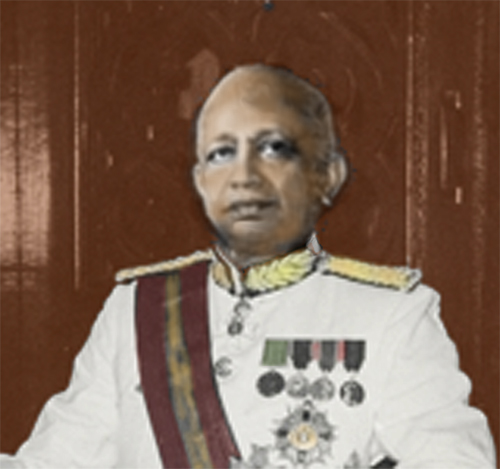
Sir Oliver Goonetilleke, Governor General of Ceylon 1954 - 1962

Sir Oliver Goonetilleke, Governor General of Ceylon 1954 – 1962

Nine years of researching the background to my novel The Devil Dancers introduced me to some fascinating historical characters. One of the most remarkable was Sir Oliver Goonetilleke, one of the key architects of Ceylon’s Independence and the first Ceylonese to hold the post of Governor-General. This is the last of three articles on one of the most brilliant statesman of his generation.

A New Home

Following his loss of office, Sir Oliver’s sudden departure from Ceylon and his final destination were matters of conjecture. A short paragraph in The Times noted his arrival in Paris along with a statement from Mr A. P. Jayasuriya, leader of the Senate, that Sir Oliver was “neither removed from office nor did he resign.” A remark that seems somewhat disingenuous in hindsight.

However, the mystery was soon resolved. England was Sir Oliver’s choice for his self-imposed exile. His friend Sir John Kotelawala had already taken up residence in the Kentish village of Biddenden following his failure to win the 1956 General Election.

Almost immediately, Sir Oliver was received into the highest levels of society. For instance, the Court and Social pages of The Times record a dinner party given “in honour of Sir Oliver Goonetilleke in honour of his relinquishing the office of Governor-General of Ceylon” by Sir Graham and Lady Rowlandson at 18 Grosvenor Square. Among the guests were the High Commissioner for Ceylon and Sir John Kotelawala.

Unlike his friend who enjoyed the tranquillity of a rural setting, Sir Oliver preferred the frenetic pace of the city, choosing to live near Hyde Park, at the heart of London. It is one of the city’s most select addresses, just over a mile from Buckingham Palace and with Apsley House, the home of the Dukes of Wellington, as a close neighbour.

Within days of Sir Oliver’s departure from Ceylon, The Times recorded a Troskyite MP questioning the House of Representatives with regard to the amount of money that the former Governor-General had been allowed to take out of the country. The sum in question was £7,000 when the normal travel allowance was only £150.

The delicate question of money resurfaced several months later when the House of Representatives raised 56,250 rupees (£4,000) to be paid to Sir Oliver in lieu of 10 months leave not taken by him when in office. A Government spokesman explained that this was to be sent to him in monthly instalments of £150, Sir Oliver having “told the British press recently that he was penniless because all his money was tied up in Ceylon.”

Doubtless, Sir Oliver had had to leave much of his wealth behind. However, just how penniless he was is open to question. Just two months after settling in England, he is recorded as having paid 1,500 guineas for a horse called Hippo at the Doncaster bloodstock sales.

Horse-racing was to be one of the many activities with which he diverted himself while abroad. He had already established himself as a leading member of the racing fraternity, being described by the Sporting Chronicle as one of the most popular and respected owners. He had raced his horses in England and France for many years, his two-year old Henrico having won the prestigious Prix de la Cascade at Longchamp in 1949. However, perhaps one of his proudest moments was being able to give the famous jockey Lester Piggott his first ride.

Despite his sadness at leaving Ceylon, Sir Oliver did not succumb to grief. Instead, he created a new life. He accepted various posts with companies related to Ceylon’s tea and rubber companies and achieved another ‘first’ when he became the first Asian underwriter at Lloyds.

He travelled extensively – especially during the English winter – paying annual visits to India. He also discovered domestic happiness after having spent many years as a widower since the death of his first wife Esther in 1931.

He first met his second wife Phyllis Miller when she visited Ceylon as secretary to the Soulbury Commission. After that, they stayed in close contact and, following his removal to London, she helped him with his business affairs. They married quietly in 1968, only announcing their marriage several months later.

However, his self-imposed exile did not guarantee immunity from deteriorating political conditions at home. Two years after Sir Oliver’s departure, Philip Gunawardena, head of the United Left Front, declared his belief that sinister forces were at play. His evidence? Recent visits to Ceylon by Lord Mountbatten, Lord Soulbury and Sir John Kotelawala, a trip to Madras by Sir Oliver and alleged telephone conversations between Sir Oliver and Dudley Senanayake.

They were flimsy threads from which to weave a plot but Mrs Bandaranaike took these claims seriously and invited Philip Gunawardena to her home for secret talks. The result was uproar with everyone accusing everyone else of betrayal and Dudley Senanayake complaining to the police that attempts were being made to establish a dictatorship. According to The Times “no one knew what was happening.”

By now, Parliament had been prorogued for a record four months and Mrs Bandaranaike was contemplating a coalition with the far Left. With an election looming the next year, the political atmosphere was rapidly becoming toxic, conspiracy was perceived everywhere and even elderly statesmen living thousands of miles away were caught up in the maelstrom.

Trial and Retribution

By the early 1970s, Ceylon had changed its name to Sri Lanka; Mrs Bandaranaike, having been temporarily been ousted by her rival Dudley Senanayake, was back in power and a new threat to stability had arisen: the JVP movement.

As part of the measures to deal with the JVP, the Government introduced the Criminal Justice Commissions Act. Under this, some 130 insurgents were jailed, including one of the JVP’s prime-movers Rohanna Wijeweera.

However, the Act had implications for several people unconnected with the JVP. It was extended to a handful of individuals accused of Exchange Control Offences – among them Sir Oliver Goonetilleke.

Aged 82, he was tried in absentia and sentenced to four years rigorous imprisonment and a fine of 950,000 rupees (£61,000).

While he could not be extradited, the sentence nevertheless had a discernible impact on his life. Having met and entertained the Queen on many State occasions, he was now banned from her presence. In a sense, he was doubly exiled. It must have been a stinging blow.

In 1977, Mrs Bandaranaike was defeated at the polls by Junius Jayewardene. He repealed the Act accusing the previous Government of having used it to destroy its opponents. Those who had been jailed under the provisions of the Act were released and an amnesty declared.

This sparked a flurry of communications between the British High Commission in Colombo and the Foreign and Commonwealth Office in London. Due to their sensitive nature, these remained embargoed for 30 years.

Now available for public viewing, these documents reveal frantic activity by diplomats and civil servants in trying to establish the exact nature of Sir Oliver’s status under the amnesty.

The question is succinctly stated in a memo to Bob Dewar at the British High Commission, Colombo from R. E. Holloway, South Asian Department, Foreign and Commonwealth Office:

“We are of course particularly interested in Sir Oliver Goonetilleke and need a full account of where he now stands under Sri Lankan law. As you probably know Sir Oliver has been under a cloud in London since he was convicted and sentenced for the Exchange Control Offences. He is no longer invited to Royal functions or to other occasions at which the Queen is present. We must now advise the Lord Chamberlain on whether, according to Sri Lankan law and in the eyes of the Sri Lankan Government, he is entirely redeemed.”

Other memos show that these concerns were due not only to the niceties of royal protocol but also to an anxiety “that the Sri Lanka Government might take it amiss if we were seen still to be treating him [Sir Oliver] as a distinguished elder statesman.”

Sir Oliver was eventually re-instated and his name cleared, allowing him to return home to Sri Lanka where he died a few months later at the age of 84. Sadly, this last chapter of his life does not reflect well on any of the individuals or authorities who had benefited from his years of devoted service. Some actively sought his final ignominy while others passively complied with it.

However, his contribution to Sri Lanka’s Independence is a lasting monument to his unique skills. In the words of his biographer, Sir Charles Jeffries: “If Ceylon makes it, this will largely be due to Oliver Goonetilleke. If she fails, it will not have been his fault.”

This article first appeared in the Colombo Telegraph on 6th December 2014.

Related Items:

Kent’s Illustrious Exiles: Sir John Kotelawala

An article on Sir Oliver’s friend and former Prime Minister Sir John Kotelawala. This article, which appeared in the Colombo Telegraph, can also be found in the archive section of this blog under June 2014.

A Tangled Web: the Abbot, the widow, the Assassin and the Prime Minister

Read about the conspiracy that led to one of the most shocking political assassinations of the 20th century. Click here
Sources:

O.E.G. Sir Oliver Goonetilleke – a biography by Sir Charles Jeffries

E.G.C. Ludowyk The Story of Ceylon, p 262 [cited in OEG p. 44]

Emergency ’58: Tarzie Vittachi

The Times digital archive

National Archives – ref: FCO 37/1922


Posted in Ceylon, Exiles, History, Independence, Sir John Kotelawala, Sri Lanka | Tagged , , , , , , , , , | Leave a comment

From Independence to Exile: The Extraordinary Story of Sir Oliver Goonetilleke (Part 2)

From Dawn to Dusk

Oliver_Goonetilleke-CT500Nine years of researching the background to my novel The Devil Dancers introduced me to some fascinating historical characters. One of the most remarkable was Sir Oliver Goonetilleke, one of the key architects of Ceylon’s Independence and the first Ceylonese to hold the post of Governor-General. This is the second of three articles on one of the most brilliant statesman of his generation.

The road to Independence

On 26 September 1947, Ceylon’s first Cabinet was sworn in. Led by Prime Minister D.S. Senanayake, the list of 14 Ministers included figures that were to play a leading role in shaping the new nation.

For instance, S.W.R.D. Bandaranaike was both Minister for Health and Local Government as well as leader of the House of Representatives. Sir Oliver and John Kotelawala also held Cabinet positions: Sir Oliver as Minister for Home affairs and Kotelawala heading the Ministry for Transport and Works.

The Times provides an interesting breakdown of the constituent parts of that Cabinet. After coyly noting that “Mr Bandaranaike … is the son of the late Sir Solomon Dias Bandaranaike and was educated at Christ Church, Oxford”, it cited four “other university men” (that is, those who had attended British universities).

Further analysis of the Cabinet revealed nine lawyers, nine low-country Sinhalese (including Sir Oliver), two Kandyan Sinhalese, two Tamils and one Muslim. Ten of the ministers were Buddhist, two were Hindus, one was a Muslim and another – Sir Oliver – was a Christian.

Prior to this appointment, Sir Oliver had been Financial Secretary and, being the first native Ceylonese to assume this post, he again made history by becoming one of the ‘Officers of State’. In this role in 1946, he became unusually outspoken.

Taking a tough stance on trade, he hinted at a heavy duty to be levied on exports of tea, warning planters that they should not expect all of the increased profit to go into their pockets. He proposed a similarly strong line against UK and US with regard to duty on rubber exports.

Referring to a recent visit to the United Kingdom, he declared: “For the first time in history the Ceylon Board of Ministers stood up against Imperialism and vested interests.”

This may, of course, be regarded as part of the general manoeuvring prior to Independence – Sir Oliver’s moves were usually part of a broader strategy – but it is an interesting departure from the usual statesmanlike neutrality which usually marked his relationships with both foreign powers and those within his own country.

Back from the abyss

In 1954, Sir Oliver enjoyed another triumph, succeeding Lord Soulbury as the first Ceylonese to exercise vice-regal power as the country’s Governor-General. In this role, he provided invaluable support to four Prime Ministers, the first of which was his old friend, Sir John Kotelawala.

However, Sir Oliver rendered his greatest service during the civil riots of 1958. An already dangerous situation had been fatally mishandled by Prime Minister S.W.R.D. Bandaranaike who, in an address to the nation, had misrepresented both the manner in which the riots had started and the persons responsible. The result was a conflagration that threatened to engulf the whole country.

Tarzie Vittachi’s account of this episode “Emergency ‘58” portrays a Prime Minister virtually paralysed by his own inadequacy. It also describes how the Governor-General broke with tradition to visit the Prime Minister in his home to impress on him the need for a State of Emergency.

In fact, it was Sir Oliver who declared the State of Emergency and martialled the armed services to quell the rioting while the Prime Minister merged into the shadows. “The Prime Minister, for reasons never openly stated by him anywhere, took the unprecedented step of passing the buck back to the Governor-General—thus making Sir Oliver Goonetilleke virtual ruler of Ceylon.”

Although critical of Sir Oliver’s showmanship and theatricality – and his attempts to silence the press – Vittachi praised qualities that made the “old fox” a perfect choice for the job: “his razor-sharp mind, his adeptness at bluffing his way through the stickiest mess, his ability to visualize the opponent’s manoeuvres three moves ahead, his sweeping cynicism, his blasé attitude to scruples which would baulk another man over weighted with conscience.”

He also recounts an extraordinary episode which, if it had become public, could easily have tipped the balance, plunging the country into civil war.

A gang of goondas attacked the iconic Buddhist temple of Nagadipa on the island of Nainativu, causing extensive damage to the temple buildings and destroying a statue of Buddha that had been donated by the Burmese government to commemorate the recent Buddha Jayanti celebrations.

In an extraordinary operation led by the Governor-General, the disaster was kept secret, the temple was rebuilt and the statue restored in a period of just eight weeks: a remarkable achievement that doubtless saved many lives.

The bloodless coup

While Sir Oliver was largely responsible for restoring calm after the 1958 riots, further political trauma was to take place the following year. On 25 September 1959, Mr Bandaranaike was fatally shot in his home, the victim of a plot masterminded by his erstwhile supporter Mapitigama Buddharakkita Thera.

Eight months later, Mr Bandaranaike’s wife Sirimavo was elected Prime Minister. Her incumbency marked a substantial shift from the more relaxed and liberal forms of government that preceded her premiership.

In the speech that opened the new Parliament, the Government announced its intention of taking over the newspapers. A few months later, the armed forces were sent into the Northern and Eastern provinces, the whole island was placed under a State of Emergency, press censorship and a curfew were imposed, the Federal Party was proscribed and 45 people, including MPs, were arrested.

In 1962, an article in The Times noted two more measures that had stirred up further opposition to the Government. These were: the taking over of private schools, many of them Roman Catholic which “was handled intemperately”; and a Bill which retrospectively imposed the death sentence for conspiracy and which “has brought the Ceylon Bar out in almost unanimous condemnation.”

A picture emerges of a Government that was beset with problems to which it responded with increasingly draconian solutions. Another brief item in The Times reported that “the Governor-General of Ceylon has extended the state of emergency, proclaimed last April, for another period.” It also noted the mutterings of Opposition MPs “alleging that the stage was being set for permanent military rule.”

Shortly afterwards, plans for a coup were discovered. The conspirators were a group of high-ranking police and army officers many of whom appear to have been Christian and were, possibly, motivated by the Government’s appropriation of faith schools.

While details of the conspiracy were vague, one of the leaders Colonel F.C. de Saram was reported to have said that, once the coup had taken place, the plotters had intended to force Sir Oliver to take over the Government. It was also claimed that both Sir John Kotelawala (at that time residing in England) and Dudley Senanayake had prior knowledge of the plot.

All of this was reported to the House of Representatives by Felix Dias Bandaranaike, Parliamentary Secretary to the Ministry of Defence and External affairs and close relative of S.W.R.D. Bandaranaike. While no evidence was adduced to substantiate these claims – and Felix Bandaranaike was careful to state that the Government had not made any allegations against the Governor-General – the damage was done. What is clear from newspaper reports is that Mr Bandaranaike never lost an opportunity to link Sir Oliver’s name with the attempted coup.

Sir Oliver offered to submit himself to investigation. However, his offer was not taken up and, without any reference to the Governor-General, the Prime Minister requested that the Queen replace him with a prominent Kandyan lawyer M.W. Gopallawa who had been Ceylonese ambassador to both Washington and Peking.

Viewed in retrospect, it looks as if the Government took advantage of the plot to mount its own counter-coup and rid itself of some ‘old-school’ politicians who it may have regarded as a threat to its own power due to their continuing influence within Ceylon and close ties with Britain.

Back in 1960, The Times had described Sir Oliver as standing “all-seeing, all-knowing” behind the interim Prime Minister Mr Dahanayake. It also made a prophetic comment: “These men have been accused of separately wishing to secure all power in their hands, but on the face of it this does not seem to be the case. At present no dictator, military or civilian, is in sight.”

Events two years later show that these fears had not been laid to rest, however groundless they may have been. With his wealth of experience, Sir Oliver was probably regarded by the executive as a potential threat to its own power, whatever his intentions.

Whatever the truth, it is clear that in his role as Governor-General, Sir Oliver had been living on borrowed time. Already by 1959, his customary 5-year period of tenure had been extended by two years and, beyond the end of that term, he had continued in office indefinitely pending the appointment of a successor.

Nonetheless, the circumstances which obliged him to leave office must have left a bad taste. It was a bitter irony that a man who had done everything to ensure his country’s stability should have been linked – however tenuously – to a coup.

Yet, despite the injustice of his treatment, he never made any public complaint or levelled any criticism at those who had sought his dismissal. According to his biographer Sir Charles Jeffries, Sir Oliver’s personal motto was ‘Service with humility’. This may well account for the dignity with which he faced the attack on his reputation.

A week after vacating the post of Governor-General, Sir Oliver quietly left Ceylon for an undisclosed destination. He was in his seventieth year and had completed 40 years of public service.

*This article first appeared in the Colombo Telegraph on 5th December 2014.

Next: Part 3 – Life in Exile

Related Items:

Kent’s Illustrious Exiles: Sir John Kotelawala

An article on Sir Oliver’s friend and former Prime Minister Sir John Kotelawala. This article, which appeared in the Colombo Telegraph, can also be found in the archive section of this blog under June 2014.

A Tangled Web: the Abbot, the widow, the Assassin and the Prime Minister

Read about the conspiracy that led to one of the most shocking political assassinations of the 20th century. Click here
Posted in Ceylon, History, Independence, Sir John Kotelawala, Sri Lanka | Tagged , , , , , , , , , , | Leave a comment